
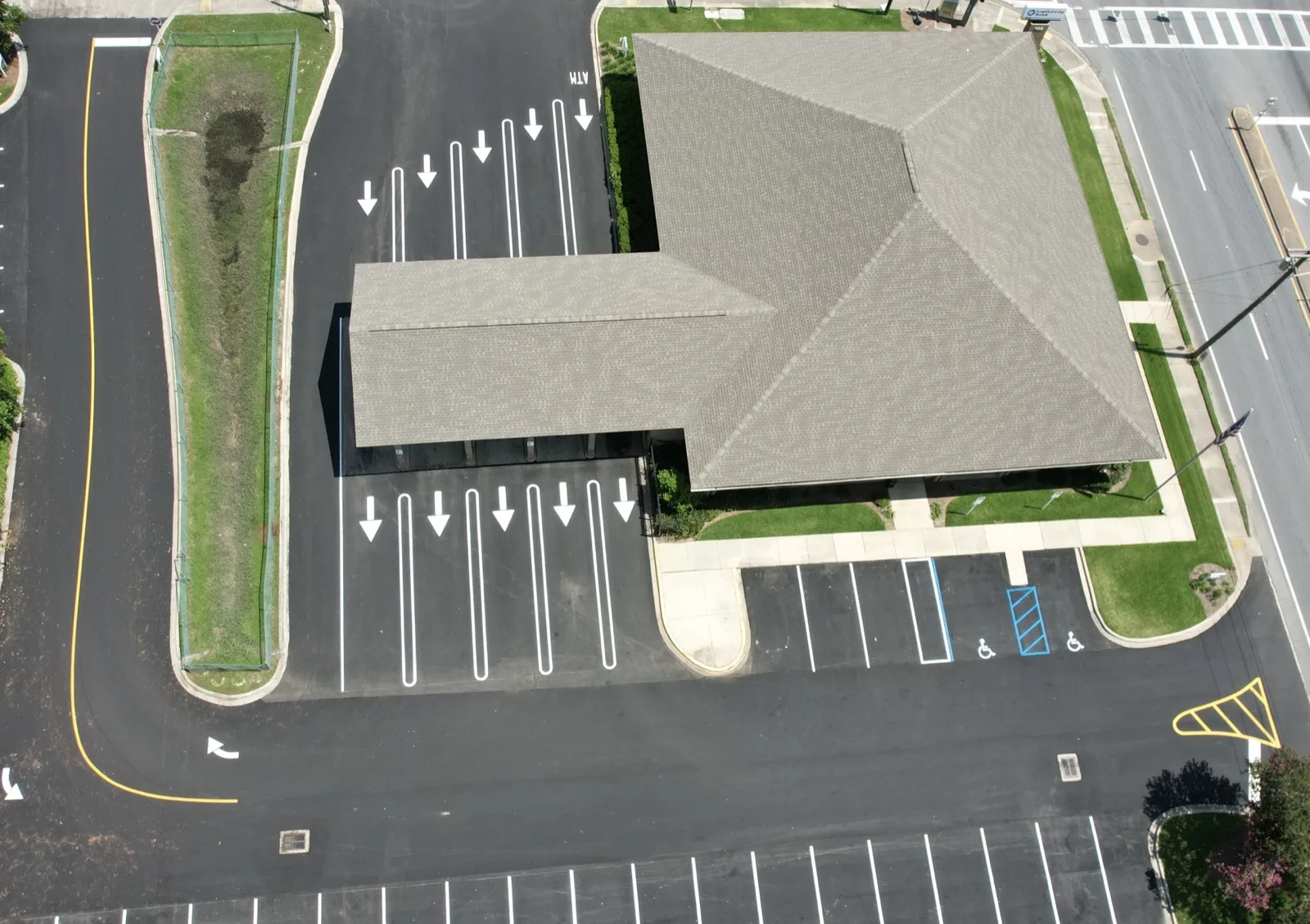
Most ADA site-access problems show up before a visitor reaches the door. Parking, striping, signs, sidewalks, curb ramps, and the path to the entrance can all trigger problems.
If you own or manage property in Perry, the main takeaway is simple. Inspect the whole site, not just the building interior. Start with the parking area, then check signs and markings, then walk the route to the entrance, and finally log repairs with photos and dates. That matters even for older properties, because barrier removal may still be required when it can be done without major difficulty or expense.
Here’s the short version of what this checklist covers:
- Accessible parking count for each lot or garage
- Space layout and whether stalls, aisles, and routes meet the listed measurements
- Visible striping and signs, including van signs
- Clear access routes from parking to the entrance
- Curb ramps with the right placement and surface condition
- Pavement defects like trip hazards, slope issues, and broken surfaces
- Records and reinspection after repairs or lot work
A few measurements from the 2010 ADA Standards for Accessible Design do most of the work on a site walk:
- Parking spaces and access aisles must stay at or below 2% slope, section 502.4
- Accessible routes should keep at least 36 inches of clear width, section 403.5.1
- Curb ramps can become a problem if cracks, ponding, or level changes over 1/4 inch show up, section 303.2
In short, this is a field checklist for site walks. I’d use it to spot issues early, fix the items that affect access first, and keep records that show the property is being checked and maintained.
Accessible Parking Checklist: Space Count, Layout, and Dimensions
Verify Required Accessible and Van-Accessible Spaces Per Lot
Count ADA spaces separately for each lot or garage.
This table is Table 208.2 of the 2010 ADA Standards. Use it to check whether each lot has the right number of accessible spaces:
| Total Spaces in Lot | Minimum Accessible Spaces | Minimum Van-Accessible Spaces |
|---|---|---|
| 1 to 25 | 1 | 1 |
| 26 to 50 | 2 | 1 |
| 51 to 75 | 3 | 1 |
| 76 to 100 | 4 | 1 |
| 101 to 150 | 5 | 1 |
| 151 to 200 | 6 | 1 |
| 201 to 300 | 7 | 2 |
| 301 to 400 | 8 | 2 |
| 401 to 500 | 9 | 2 |
| 501 to 1,000 | 2% of total | 1 per 6 accessible spaces, or fraction of 6 |
| 1,001 and over | 20 + 1 per 100 over 1,000 | 1 per 6 accessible spaces, or fraction of 6 |
The van column follows section 208.2.4: one van space for every 6, or fraction of 6, accessible spaces. Accessible spaces should be placed on the shortest accessible route to an accessible entrance.
For lots with 4 or fewer spaces, the required accessible space must be van-accessible. Signage is not required in that case, under the exception at section 216.5, but the width, slope, and clearance rules still apply.
After you confirm the count, move on to the size and layout of each space.
Measure Stall Width, Access Aisle Width, and Slope
Use a tape measure and slope meter during every inspection.
Neither the parking space nor the access aisle can exceed 2% (1:48) slope in any direction, under section 502.4. That includes both running slope and cross slope.
The federal minimums are a floor, not a target. Section 502.2 sets a car accessible stall at 96 inches (8 feet) wide and a van stall at 132 inches (11 feet) wide, and section 502.3 sets the access aisle at 60 inches (5 feet) wide, running the full length of the stall. On North Florida commercial lots, American Curb Appeal stripes accessible parking to a 12-foot van stall with a 5-foot access aisle, inside a 17-foot stall depth envelope. Those numbers drive the whole layout, because a lot that was striped tight for standard stalls rarely has room left over once the accessible stalls and aisles are laid out correctly.
The access aisle also needs to connect straight to an accessible route that is at least 36 inches wide and leads to the entrance without crossing curbs or stairs. If that route runs in front of the parking spaces, wheel stops should be installed so parked vehicles do not cut the clear route width below 36 inches.
This is where a lot of sites get tripped up. The number of spaces may be right, but the layout can still fall short if the stall, aisle, or route is too narrow or too steep.
Car vs. Van Space Comparison Table
| Feature | Standard Accessible (Car) | Van-Accessible |
|---|---|---|
| Minimum Stall Width (502.2) | 96 in. (8 ft.) | 132 in. (11 ft.) |
| Minimum Access Aisle Width (502.3) | 60 in. (5 ft.) | 60 in. (5 ft.) |
| Narrow-Stall Option (502.2) | Not applicable | 96 in. stall allowed where the aisle is 96 in. wide |
| Max. Slope, Any Direction (502.4) | 2% (1:48) | 2% (1:48) |
| Min. Vertical Clearance (502.5) | Not required | 98 inches |
| Signage (216.5) | ISA sign | ISA sign plus van designation |
Van-accessible spaces need a minimum vertical clearance of 98 inches along the driving route to and from the space.
Once the dimensions check out, review the striping and ADA compliance signs next.
Striping and Signage Checklist: Markings That Must Stay Visible
Inspect Accessible Symbols and Access Aisle Striping
Once you’ve checked space count and dimensions, look at the markings that make each space easy to spot and enforce. Every accessible space must have the International Symbol of Accessibility (ISA) on the pavement and a permanent sign. If the symbol is faded, chipped, or hard to read, restripe it and replace the sign.
Access aisles also need diagonal hash marks so drivers don’t park in that striped area. Federal law does not set a required color, but blue and white are common because they stand out well against pavement. If the striping looks dull, patchy, or tough to see in daylight, it may be time to restripe.
Heavy traffic, sun, and summer storms wear markings down faster than most owners expect, so judge the lot by how the markings actually read in daylight rather than by the calendar alone. Fast-cure striping paint keeps the disruption short: a lane or a bank of stalls can usually reopen about 30 minutes after the last pass, so the work can be staged around business hours.
If the markings have been worn down, covered, or changed, check them again after any parking lot work. Any time a paving contractor resurfaces the driving surface, or the lot layout changes, the affected area needs a full ADA striping review before the new markings are locked in.
Confirm Mounted Signs and Van Designation
Then check the signs themselves. Pavement markings by themselves are not enough. Every accessible space, except in lots with 4 or fewer total spaces, also needs a permanently mounted sign with the ISA.
Under section 502.6, the bottom edge of each sign must be at least 60 inches above the finish surface so it stays visible when a vehicle is parked there. If the sign sits within a pedestrian circulation path, the clearance to the bottom of the sign is 80 inches under section 307.4. Use a tape measure on every site walk. Don’t guess.
Make sure the van designation is in place, easy to read, and not blocked by landscaping, pallets, or anything else. If something is in the way, clear it or replace the sign right away.
| Signage Element | Requirement |
|---|---|
| ISA Sign | Required at every accessible space, except in lots with 4 or fewer total spaces (216.5) |
| Van Designation | At least one van space per 6, or fraction of 6, accessible spaces (208.2.4) |
| Minimum Sign Height | 60 inches to the bottom of the sign (502.6) |
| Pedestrian Path Height | 80 inches if located within a pedestrian circulation path (307.4) |
| Visibility | Must remain visible when a vehicle is parked in the space |
Log each inspection with photos and dates so you have a record of compliance.
Accessible Route Checklist: Sidewalks, Curb Ramps, and Obstructions
Walk the Route from Parking to the Entrance
After you check parking spaces, striping, and signage, look at the path people actually use to get to the door.
A parking area can still fail compliance if the route to the entrance is blocked, broken, or hard to use. The path from the access aisle to the entrance must be continuous and unobstructed.
Walk the full route on foot. That matters because many route problems don’t show up from a distance. Keep 36 inches of clear width (403.5.1). Where the clear width drops below 60 inches, section 403.5.3 calls for a passing space at least 60 by 60 inches, no more than 200 feet apart. Remove obstructions like planters, bollards, signs, landscaping, wheel stops, utility covers, and pavement gaps. Also check for objects mounted 27 to 80 inches above the ground that stick out more than 4 inches into the path, which section 307.2 does not allow.
Use a digital meter to measure running slope and cross slope. Under section 403.3, the route should not exceed 1:20 (5%) running slope, and cross slope must stay at or below 2% (1:48). Re-walk the route on a regular cycle, and again after any pavement work or major storm.
Next, check each curb ramp anywhere the route crosses a curb.
Check Curb Ramp Placement, Slope, and Surface Condition
Where a walkway meets a curb, install a curb ramp. The ramp must sit on the shortest accessible route to the entrance and must not extend into a parking space or access aisle.
Check the ramp’s slope, width, landing size, side flares, and surface condition. The maximum running slope is 8.33% (1:12) under section 405.2, cross slope must stay at or below 2% (1:48) under 405.3, minimum clear width is 36 inches under 405.5, the landing must be at least 36 inches long under 406.4, and side flares cannot exceed 10% (1:10) under 406.3.
Detectable warnings, the truncated dome panels, cause more confusion than any other ramp item. The rule requiring them on curb ramps, section 406.8, sits in the Department of Transportation standards for transit facilities, and was not carried into the Department of Justice 2010 Standards that govern a private commercial lot. Keep any panels you already have in good repair, and check the Florida Building Code and your local building department before adding or removing them.
Look closely at the surface. Cracked concrete, settled panels, uneven transitions at ramp edges, ponding, and any level change over 1/4 inch can all create problems and may need repair. Section 303 allows a vertical change up to 1/4 inch, and requires anything between 1/4 and 1/2 inch to be beveled.
| Curb Ramp Element | ADA Requirement |
|---|---|
| Maximum Running Slope | 8.33% (1:12), section 405.2 |
| Maximum Cross Slope | 2% (1:48), section 405.3 |
| Minimum Ramp Width | 36 inches, section 405.5 |
| Landing Length | 36 inches minimum, section 406.4 |
| Maximum Side Flare Slope | 10% (1:10), section 406.3 |
| Detectable Warnings | Required at transit facilities (DOT 406.8), not by the DOJ 2010 Standards for private lots; confirm local code |
| Maximum Level Change | 1/4 inch vertical, section 303.2 |
If a paving contractor resurfaces or rebuilds the driving surface, treat that work as an alteration. Then review the curb ramps and the accessible route under the current 2010 ADA Standards.
Pavement Condition and Repair Priorities for Perry Properties
Identify Surface Defects That Create Access or Liability Risks
Not every pavement defect affects ADA access. But the ones that do should move to the top of your repair list.
After you check parking, striping, and access routes, look closely at the pavement itself. Even small surface problems can interrupt access. A 1/4 inch vertical separation at a joint, a settled panel, or a ravelled edge is a trip hazard, not a cosmetic issue.
Focus first on defects that block travel or create trip hazards. Slope problems can be harder to spot than cracks or broken edges, but they can still make a space noncompliant. Open cracks in the accessible route and the stalls around it are worth sealing with hot rubberized crack filler before they widen, and failed areas can be cut out and patched with hot-mix rather than left to spread across the aisle. If the failure runs deeper than a patch can reach, have the lot assessed by a paving contractor rather than repairing the same square of pavement again.
Document, Prioritize, Repair, and Reinspect
Once the site is documented, move findings into repairs in this order:
- Trip hazards over 1/4 inch
- Slope violations in stalls and aisles
- Broken curb ramps
- Missing or damaged signs
- Faded striping
Photograph each defect with a tape measure in view. Log the location and date. Then complete repairs in priority order, and reinspect and remeasure after surface work.
Keep your inspection, repair, and photo records on file so you can show a consistent, ongoing compliance effort.
FAQs
How do I know which ADA issues to fix first?
Start with high-risk violations that most often lead to complaints or failed inspections. Focus first on damaged curb ramps, excessive slopes, and trip hazards like concrete uplifts over 1/4 inch.
Then move to visible access issues that are easy to spot but still matter: faded parking striping, missing or poorly mounted signage, and obstructions in access aisles.
A simple check can help here. Use a level or digital slope meter to confirm accessible routes and parking spaces stay within the 2% maximum slope.
Do older properties still have to meet ADA site access rules?
Yes. The ADA applies to parking lots that serve places of public accommodation or commercial facilities, and older properties are not exempt.
If an older site has inherited limits, the owner should still review the lot for layout changes or surface repairs that may be needed. Regular maintenance and planned upgrades can help cut liability and support safe, day-to-day access.
How often should I inspect parking lots and access routes?
Make a quick walk of the parking lot and the access routes part of your routine property rounds, and put a closer, measured review on a regular cycle, tape measure and slope meter in hand.
You should also inspect the site any time a contractor resurfaces the lot or does other construction work, and after a major storm. That helps confirm the area still meets the 2010 ADA Standards for Accessible Design. Keep photos and records of any corrective actions.
Need parking lot maintenance?
Contact us today for a free proposal on your next pavement project.
Get Your Free Proposal