
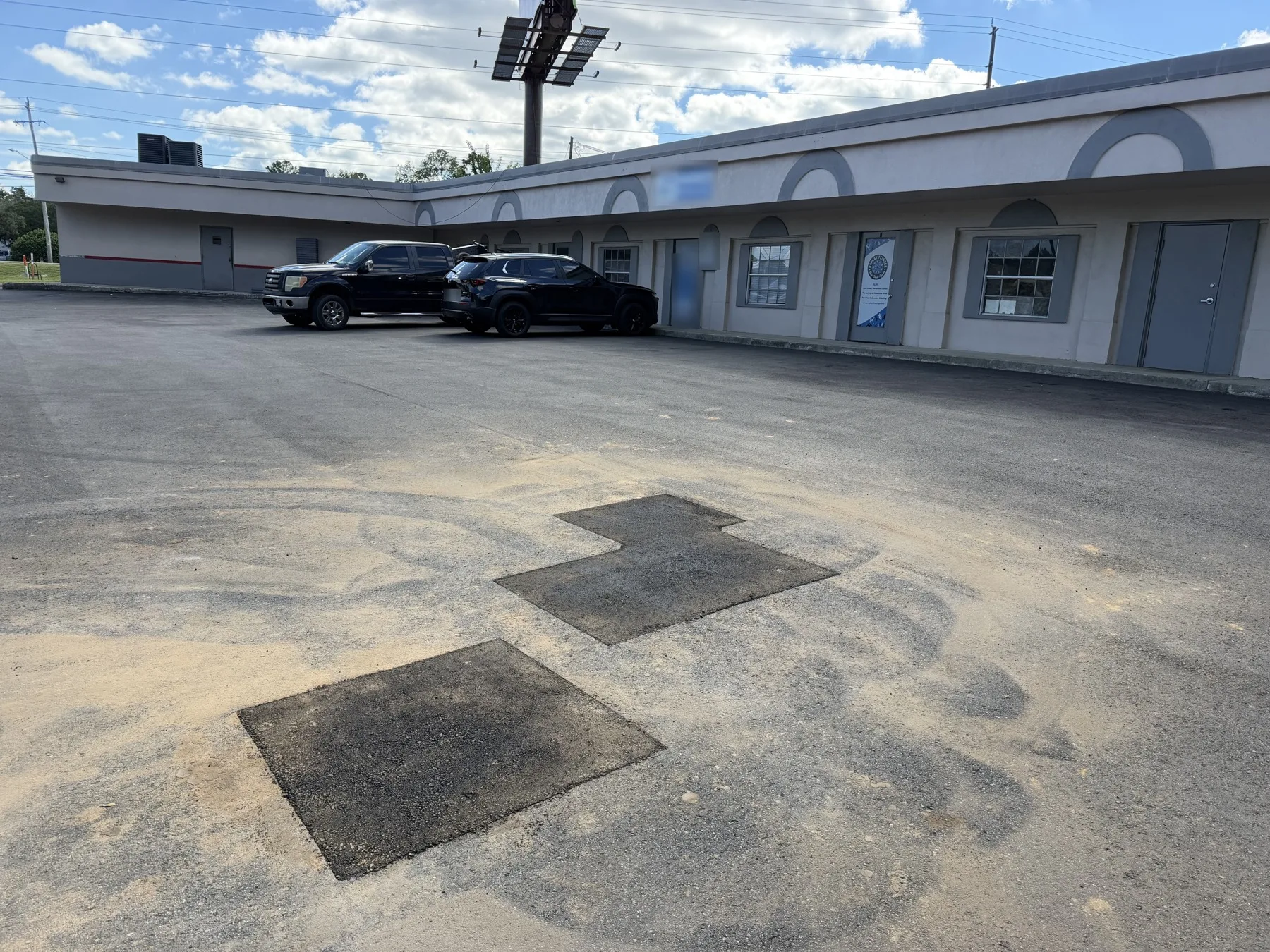
A utility cut is a hole with torn edges and disturbed dirt in it, so closing it correctly means squaring the edges, rebuilding and compacting what is underneath, and then compacting the new asphalt so water cannot get back in. Most of the failed patches we get called out to look at were not failures of asphalt. They were failures of preparation. When a plumber or an electrician has to open your lot in a hurry, the repair that follows is a separate job with its own standards.
Here's the short version:
- The edges of a utility cut are broken and ragged, and they have to be saw cut smooth at right angles before any asphalt goes in.
- Loose dirt and broken asphalt have to come out, and the area has to be dug out and compacted so the patch has something solid to sit on.
- New asphalt goes in at a real thickness, raked level with the surrounding pavement, then fully compacted.
- A cut that is skipped or thrown in loose usually shows up as a sunken, crumbling rectangle within a few months.
What a Utility Cut Actually Does to Your Pavement
An emergency waterline or conduit repair is not a neat operation, and it is not supposed to be. The crew has a leak or an outage to fix, so they break through the asphalt, dig down to the line, do the work and backfill. What they leave behind is a hole with three problems in it.
The first is the edge. Asphalt broken by a jackhammer or a bucket does not break on a clean plane. It fractures back under the surface, leaving thin overhangs and loose chunks that look like solid pavement but are not attached to anything.
The second is the fill. Backfilled soil that has not been placed and compacted in a controlled way holds air. Air closes up under traffic. That is why the classic bad utility patch sinks into a shallow bowl within a season or two.
The third is water. A cut creates a continuous seam from the surface straight down to the base, and in North Florida our rain finds that seam fast. The same thing that makes an unsealed crack dangerous applies here at a much larger scale, which we cover in Don't Ignore Cracks: Why Water Damages Your Foundation. Once water saturates the lime rock base, the base stops carrying vehicle weight.
How We Closed a Utility Cut on Apalachee Parkway
On September 25, 2026, we did an asphalt repair on Apalachee Parkway in Tallahassee for a repeat customer, a property owner whose lot had been opened up by plumbers making an emergency waterline repair. The sequence we followed there is the same one we follow on every utility cut.
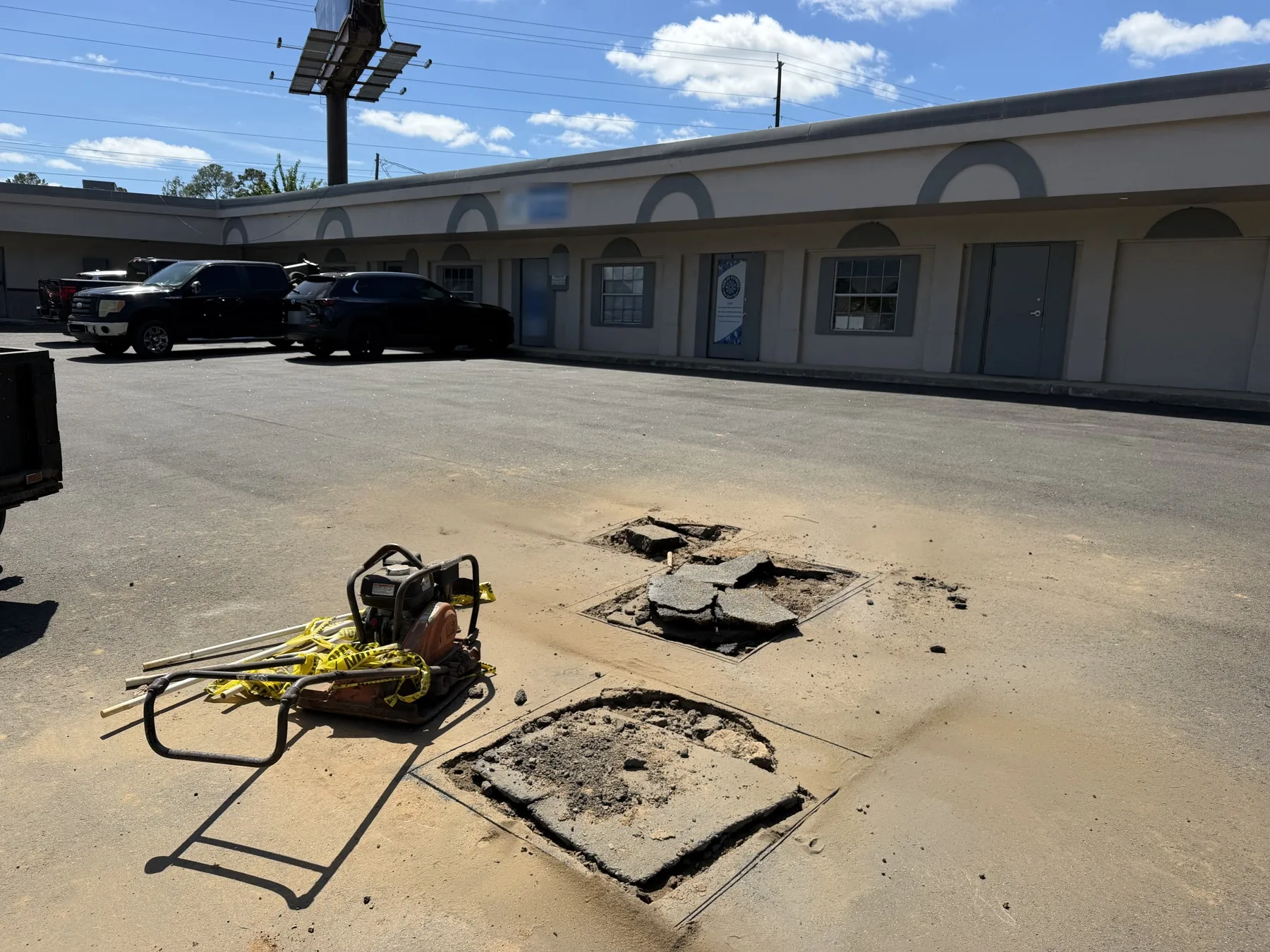
Saw cut the edges smooth at right angles
Before anything else, we saw cut the perimeter of the repair area. That turns a ragged break into a clean vertical face at right angles to the surface. A square edge gives the new hot mix a full thickness joint to press against, instead of a feathered lip that cracks under the first truck that rolls over it. It also lets us cut back past the fractured asphalt so we are joining to pavement that is genuinely sound.
Remove the broken asphalt and excess dirt
Everything loose comes out. Broken asphalt, excess backfill dirt, anything that will not hold a load. This is the step that gets skipped most often, because it is the step that takes labor and hauling rather than material.
Dig out and compact the base
We dug the area out at least an inch and a half to two inches and compacted it. That depth creates room for a real asphalt thickness instead of a thin skim, and the compaction is what keeps the patch from sinking. A compacted base does not settle the way loose fill does, and settlement is the single most visible sign of a bad utility patch.
Place 9.5mm spec asphalt and compact the surface
We placed two inches of 9.5mm spec asphalt, raked it level and smooth so it sits flush with the surrounding pavement, then fully compacted it. Raking level matters because a high patch becomes a scraping point and a low patch becomes a puddle. Compacting the top matters because dense asphalt is what keeps water from working down through the new material and back into the base you just repaired. This is the same full depth approach we use across our Asphalt Restoration & Structural Repair work, including professional grade liquid asphalt tack to weld new hot mix to old pavement.
A squared utility cut in a Tallahassee parking lot closed with new asphalt, raked flush with the surrounding surface.
What a Badly Closed Cut Looks Like a Few Months Later
You can usually read the quality of a utility patch from the driver's seat once a rainy season has passed over it.
| What you see | Properly closed cut | Rushed or skipped closure |
|---|---|---|
| Shape of the repair | Clean rectangle, straight edges | Irregular outline with crumbling edges |
| Surface level | Flush with the pavement around it | Sunken bowl, sometimes well below grade |
| After rain | Water sheets across it | Standing water sits in the depression |
| Joint condition | Tight seam | Open gap you can put a key into |
| Traffic noise | Nothing unusual | Thump as tires drop into it |
The sunken bowl is the one that costs you the most, because it turns into a water collection point directly over the utility line that was just repaired. From there the failure spreads outward into pavement that was fine before anyone dug.
Why You Should Not Wait Long After the Utility Crew Leaves
Utility crews are usually responsible for the line, not the pavement. In many cases they backfill, put down something temporary and move on to the next emergency. That temporary condition is where owners lose money, because every rain event and every delivery truck works the open seam a little wider.
If the cut is still open or filled with gravel, it is also a trip and liability concern in a pedestrian area, and an open seam next to a sidewalk can affect the path of travel your tenants use. Where a cut crosses curbing or a sidewalk panel, the concrete side has to be rebuilt too, which falls under Concrete Construction & Repair rather than asphalt work.
Once the patch is in and compacted, it becomes part of your regular maintenance cycle like the rest of the lot. Asphalt Crack Repair is the step that keeps water from finding the perimeter of the patch again.
Getting Your Cut Closed Properly in Tallahassee
American Curb Appeal has been doing parking lot repair in Tallahassee since 1998, which is 28 years of working on existing commercial pavement rather than new paving. We are insured and bonded, we serve Tallahassee, Crawfordville, Quincy, Havana, Monticello, Perry, Madison, Lake City, Apalachicola and Live Oak, and we hold a 4.9 rating across 30 Google reviews.
If a plumber, electrician or utility crew has opened up your lot, call us at (850) 545-1776 or request a walk through our asphalt repair and base stabilization service. The sooner the cut is squared up and closed, the smaller the repair stays.
FAQs
Is the utility company or plumber supposed to repair the asphalt?
That depends entirely on your agreement with them, and it is worth asking before they start digging. Many emergency crews restore the line and backfill the hole but do not close the pavement to a finished standard. If that is the case, the asphalt repair is a separate scope of work that belongs to the property owner.
Why do the edges have to be saw cut if the hole is already open?
Because asphalt broken by digging equipment fractures underneath the surface, leaving loose overhangs that look solid from above. Saw cutting gives us a clean vertical face at right angles so the new hot mix has full thickness pavement to bond against. Skipping that step is the most common reason a patch starts unravelling at the seam.
My patch from last year has sunk below the pavement around it. What happened?
Almost always the backfill underneath was not compacted, so it consolidated under traffic and the asphalt went down with it. Resurfacing the dip without addressing what is below it will give you the same result again. We open it back up, remove the loose material, compact the base and rebuild the patch at a proper thickness.
Should the whole lot be sealcoated after a utility patch?
Sealcoating is a protective skin, not a structural filler, so it will not fix the cut. Once the patch is placed and compacted, sealing the lot is a reasonable next step for UV and water protection on the surrounding surface. We would look at the condition of the whole lot before recommending it.
Need parking lot maintenance?
Contact us today for a free proposal on your next pavement project.
Get Your Free Proposal