
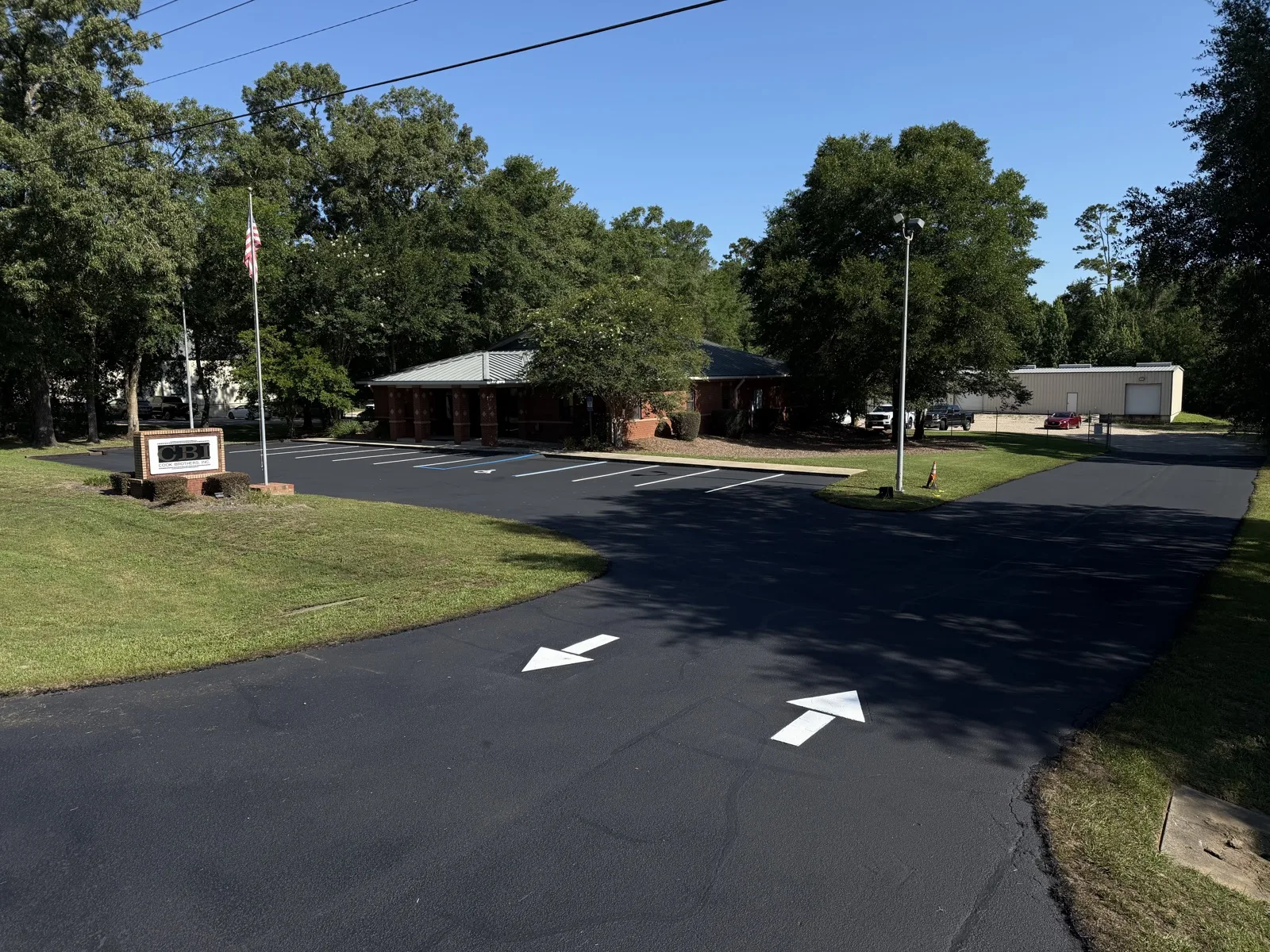
We just entered the brutal summer months here in Tallahassee, and the record heat is making asphalt maintenance a serious battlefield. For business owners and property managers, handing over your parking lot to a sealcoating crew is a logistical juggling act. You have to reroute traffic, notify tenants, and squeeze the work into a tight two-day window.
When the crew packs up and the lot looks like a beautiful, uniform sheet of charcoal black, you breathe a sigh of relief. But then, you walk out onto the pavement on a blistering 97-degree afternoon, press your heel down, and notice the sealer feels a bit “tender.” Or worse, a delivery truck makes a sharp turn, leaving a temporary scuff mark.
Your first instinct might be to worry: Did the contractor mess up the mix?
In an industry where some fly-by-night or novice crews definitely do mess up the mix, it’s a fair question. But if your lot was sealed correctly, that temporary midday softness isn’t a failure—it’s actually the physical proof of a high-performance, long-lasting application. Welcome to the Longevity Trade-Off.
The Anatomy of a Bad Mix vs. A Proper Mix
In our region, most reputable contractors use similar baseline materials—typically a high-quality Coal Tar sealer like SealMaster or Star-Seal. (Unless they are trucking in cheap Asphalt Emulsion sealers from down the road, which are practically guaranteed not to last in our North Florida climate).
Since the base materials are often similar, the real difference comes down to mix integrity.
When a contractor doesn’t know how to mix properly for the weather, or if they take shortcuts, they over-dilute the material with water and skimp on the expensive rubberized additives (latex). On a scorching 97°F day, an improper, weak mix without latex might actually “flash dry” and feel hard to the touch very quickly. But because it lacks the necessary polymer “glue,” that brittle shell will begin to micro-crack, flake, and wear away within 6 to 12 months.
When we mix a commercial-grade Coal Tar sealer for a project, we mix for a 3-to-5-year lifespan. That means adding a robust 2.0% to 3.0% latex polymer network and packing it with clean sand for traction and durability. This creates a bulletproof barrier, but it introduces a major physical reality in the summer heat.
The “Rubber Band” Effect and Trapped Moisture
- Elastic Memory: The heavy latex injection creates millions of microscopic rubber bands within the cured sealer. This is what allows the sealer to stretch and flex with the asphalt during temperature swings instead of cracking.
- The Evaporation Brake: Latex holds onto water tightly. On a hot afternoon, the intense sun quickly bakes the very top surface of the sealer, creating a microscopic skin. This skin acts as a throttle, forcing the deeper moisture to slowly breathe out over 48 hours.
- The 150-Degree Heating Pad: When our Tallahassee air hits 97°F in direct sunlight, the black asphalt surface easily skyrockets past 150°F. Because a properly mixed sealer is highly rubberized and thermoplastic, it will naturally become slightly pliable under that intense heat until every drop of residual moisture completely escapes.
Our Foolproof Quality Test: The Hand-Wash Test
Out on the job site, we have a definitive test for mix quality.
If a contractor’s mix easily rinses off their crew’s hands with a standard garden hose, the mix is weak and it will wear off from the asphalt just as easily.
But when a mix is engineered correctly with the right amount of latex, the sealer dried on our skin does not come off without a fight. It requires heavy-duty pumice soap or a strong citrus cleanser, a stiff scrub brush, and serious elbow grease to clean off. That stubborn, tenacious bond is exactly what is happening on your parking lot.
We don’t mix for how the lot looks tomorrow morning; we mix for how it holds up three years from now.
What to Expect in the First 48 Hours
If you see visual power-steering marks or a bit of surface tenderness during the heat of the day on a freshly sealed lot, don’t panic.
- It’s Cosmetic: These are just surface distortions in the pliable top layer. The rubberized matrix underneath is locked tight onto your asphalt.
- Self-Healing: As cars drive straight over the lot and the evening temperatures cool the pavement back down, these marks naturally smooth out, blend in, and disappear within a few weeks.
- The Long-Term Win: By trading a tiny bit of cosmetic tenderness during the first two midday heat spikes, you are gaining years of durability, structural protection, and deep black curb appeal.
When it comes to protecting your asphalt investment, instant gratification usually means a short-lived product. We don’t mix for how the lot looks tomorrow morning; we mix for how it holds up three years from now. Keep the wheels rolling straight for the first 48 hours, and let the science of a premium mix do the heavy lifting.
Need parking lot maintenance?
Contact us today for a free proposal on your next pavement project.
Get Your Free Proposal