
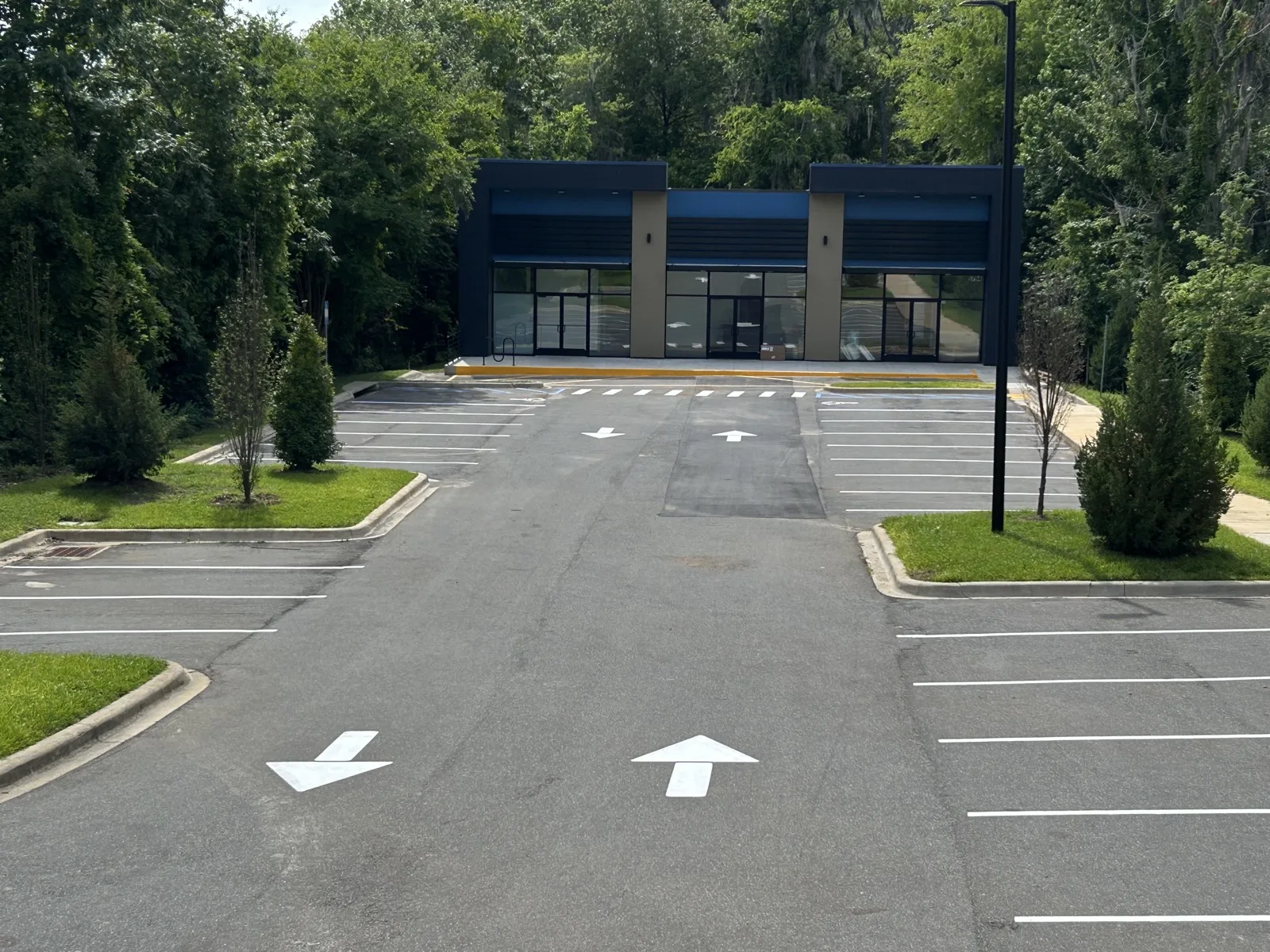
Parking lot striping is more than painted lines. It is a practical way to improve safety and organization in busy areas like Lake City. Clear, visible markings guide drivers, protect pedestrians, and help avoid accidents. Faded or missing lines lead to confusion, collisions, and liability exposure for property owners. Regular maintenance with durable, high-contrast striping materials keeps a lot compliant and functional.
Key takeaways:
- Traffic flow: Lane markings and arrows reduce confusion and improve navigation.
- Accident prevention: Defined parking spaces and crosswalks lower the risk of collisions.
- Regulatory compliance: ADA and fire lane markings are legally required.
- Durable materials: High-contrast, weather-resistant paints keep markings visible in all conditions.
Professional striping keeps your parking lot safe, organized, and compliant while minimizing disruption to the business using it.
Clear Lane Markings Improve Traffic Flow
Directing Vehicle Movement
Lane markings, including directional arrows and lane lines, guide drivers along the routes the lot was designed around. These visual cues reduce confusion and encourage safer navigation. Stop bars at internal intersections help manage right-of-way and hold vehicle speed down, which matters most where a drive aisle meets a main entrance.
Laid out with precision, these markings define vehicle boundaries and keep bottlenecks from forming at the pinch points of a lot. Markings in the busiest travel lanes wear faster than the ones inside parking stalls, so the traffic pattern is usually the first thing to go faint.
Clear guidance does more than move vehicles. It removes the hesitation that causes drivers to stop where they should not.
Preventing Driver Confusion
High-visibility markings at entry and exit points make it easy for drivers to identify the correct route. That eliminates guesswork and prevents the abrupt stops that back traffic up into the street. Painted ground instructions such as "Loading Zone" or "No Parking" deliver instant clarity and keep lanes unobstructed.
Faded or deteriorating markings do the opposite. Once lines become hard to see, drivers stop following the intended layout, invent their own lanes, and behave unpredictably. Re-striping, painted ground messages, and correct sign placement are what bring the layout back.
Well-Defined Parking Spaces Prevent Collisions
Clear, well-marked parking spaces are the foundation of a safe lot in Lake City.
Marking Individual Parking Spots
Clearly marked stalls create visual boundaries, making it easier for drivers to center their vehicles. When spaces are well defined, drivers are far less likely to drift into a neighboring stall or scrape another vehicle. Stall width and depth should be laid out to the local code and the lot's actual traffic pattern rather than eyeballed off the old, faded lines.
Faded or unclear lines cause cars to park at odd angles or straddle two spaces. That disrupts circulation and raises the odds of minor collisions and door dings. Fresh, bright striping removes the uncertainty and keeps parking orderly.
Material choice drives how long that clarity lasts. Fast-cure striping paint lets a lot reopen roughly 30 minutes after the last pass, so a section can be closed, striped, and handed back within the same visit instead of taking the lot out of service for a day.
Maximizing Parking Space
Proper striping does more than guide drivers. It makes the most of the space you already have while reducing collision risk. A professional layout accounts for traffic flow, pedestrian paths, building entrances, and nearby structures, and on the lots American Curb Appeal stripes it works to a 17-foot stall depth envelope. Drive aisle widths come off the local code and the way the lot is actually used, not off whatever room is left once the stalls are drawn.
Re-striping frequency depends on the lot. High-traffic retail and medical lots fade faster than a lot that fills once a day and sits. The practical test is visibility, not the calendar: when the lines are hard to read from a moving car, the lot is due. Regular upkeep of parking lot lines is a simple, low-cost step toward overall safety and efficiency.
Marked Pedestrian Crossings and Walkways
Clearly marked crosswalks and walkways create safer routes for people on foot and cut the risk of a vehicle striking a pedestrian.
Making Crosswalks More Visible
High-contrast striping is a simple, effective way to make crosswalks impossible to miss. These markings tell drivers to slow down and watch for pedestrians. Durable, high-visibility marking materials hold up well in Lake City, where heat, humidity, and hard afternoon rain punish anything applied to pavement.
Adding painted messages such as "YIELD" or "PEDESTRIAN CROSSING" alongside ADA-compliant signage reinforces the expected behavior for drivers and pedestrians alike.
Protecting Pedestrians in High-Traffic Areas
Zones where vehicles and pedestrians cross constantly, such as entrances, exits, and the path from the far row to the front door, need more than a painted line. Wheel stops at the head of a parking stall keep vehicles from rolling into a walkway and give pedestrians a protected edge to walk along.
The pavement itself matters as much as the paint. A vertical separation at a walkway edge, a curb transition, or a patched seam is a change in level, and ADA section 303 only lets it stand square up to a quarter inch. Between a quarter inch and a half inch it has to be beveled at a slope no steeper than 1:2, and anything over a half inch has to be treated as a ramp. No amount of fresh striping fixes that. Repairing those edges before striping is what keeps a marked walkway genuinely safe.
Fire Lanes and ADA-Compliant Parking Zones
Fire lanes and ADA-compliant parking zones are what keep emergency access open and the property usable for people with disabilities. These markings are not optional courtesies. They are required under local fire codes and federal accessibility law, and ignoring them leads to fines and failed inspections.
Keeping Emergency Access Clear
Fire lane striping holds a clear path for fire trucks and ambulances when it counts. The markings signal a no-parking zone, so responders can reach the building without working around a parked car. Properly marked fire lanes also give large apparatus the room to maneuver. The International Fire Code sets the unobstructed width of a fire apparatus access road at 20 feet in section 503.2.1, and its aerial apparatus appendix raises that to 26 feet where a building is tall enough to need an aerial device. Lake City property owners should confirm those widths along with their fire lane markings and lettering with the local fire marshal, because the adopting code, the exact wording, the color, and the curb treatment vary by jurisdiction.
Fire lanes protect emergency access. ADA zones protect everyday access.
Meeting ADA Requirements
ADA-compliant parking follows the 2010 ADA Standards for Accessible Design, and the number of accessible spaces required comes straight off Table 208.2, scaled to the total number of stalls in the lot:
- A lot with 1 to 25 spaces must have at least one accessible stall.
- A lot with 26 to 50 spaces must include two accessible stalls.
- At least one of every six accessible stalls, or fraction of six, must be van-accessible under section 208.2.4, so a lot with a single accessible stall needs that one to be van-accessible.
| Total Parking Spaces | Minimum Accessible Spaces |
|---|---|
| 1 to 25 | 1 |
| 26 to 50 | 2 |
| Van-accessible ratio | 1 for every 6 accessible spaces |
Every accessible stall needs an adjacent access aisle marked so drivers stay out of it, commonly with diagonal hatching, because that is the space a wheelchair lift or ramp has to deploy into. On the layouts American Curb Appeal stripes, the van-accessible stall runs a 12-foot stall with a 5-foot access aisle, which sits above the minimum van stall width in the 2010 Standards. Signage carrying the International Symbol of Accessibility goes with it, and section 502.6 puts the bottom of that sign at least 60 inches above the ground so it stays readable when a vehicle is parked in the stall. The van stall's sign also has to carry the words "van accessible".
The requirement most often missed is not painted at all: the stall and its access aisle have to stay within a 2 percent maximum slope in every direction. That is set by the pavement, so a lot that has settled or been patched unevenly can fail inspection even with perfect new striping.
High-Contrast and Reflective Materials for Lake City Weather
Safety in Lake City starts with materials that survive the weather. Hot, humid conditions and heavy summer rain wear markings down fast, so weather-resistant products are not a luxury. Quality paints and reflective materials keep markings readable under blazing sun and in a downpour alike.
Weather-Resistant Paints
Thermoplastic is the heavy-duty end of the range. It goes down as a thick layer that bonds to the pavement, so it resists fading and abrasion better than conventional paint in the hardest-worn travel lanes. Fast-cure traffic paint sits at the other end: less material, far faster reopen, and easy to refresh on a regular cycle.
Whichever you choose, the surface underneath decides the result. Sealcoating with a high-solids sealer built to the FDOT spec restores a dark, uniform surface, and white and yellow lines pop against it in a way they never will against gray, oxidized asphalt. Sealing first also gives the paint a clean, sound surface to bond to, which is most of the reason striping fails early.
Reflective Markings for Low-Light Conditions
Visibility after dark is its own problem. Reflective marking materials return headlight glare to the driver, which makes them far easier to pick up at night or during one of Lake City's afternoon thunderstorms than flat paint. That matters most in commercial lots that stay busy with both vehicles and people on foot after sunset.
Reflective surfaces only work when they are clean. Dirt, tire rubber, and organic growth dull the return, so keeping the lot swept and washed is part of keeping it visible. Walking the lot at night, headlights on, is the fastest honest test of whether your markings still do their job.
Why Hire Professional Striping Services
DIY striping rarely meets code, and a lot that fails inspection has to be redone anyway. A professional crew brings the layout experience, the equipment, and the material knowledge to get a compliant lot on the first pass with minimal disruption. American Curb Appeal has been maintaining commercial pavement across North Florida since 1998, and striping is the core of that work.
Knowledge of Local Regulations
A professional striping crew works to ADA requirements, local fire lane rules, and MUTCD standards every day, so the stall counts, aisle widths, slopes, and signage are right before the inspector shows up rather than after. The ADA requires businesses open to the public, along with the commercial facilities and parking garages that serve them, to provide accessible parking, and a layout error in that part of the lot is the expensive kind to fix.
Minimal Business Interruption
Closing a lot costs a business real money, so the schedule matters as much as the striping. Work can be staged section by section so part of the lot stays open, and fast-cure striping paint lets a striped area reopen roughly 30 minutes after the last pass. Ask any contractor how they plan to phase the work and how soon each section comes back into service before you book the date.
Doing the pavement prep in the same visit helps too. Crack sealing and sealcoating before the lines go down give the paint a sound surface to bond to and cut down on early touch-ups.
Conclusion
Parking lot striping does more than mark spaces. It keeps drivers, pedestrians, and property owners in Lake City safer. Clear markings for lanes, stalls, crosswalks, and fire lanes manage traffic flow, reduce accidents, and keep emergency access open.
When striping fades, disorder follows. Drivers hesitate, invent lanes, and park haphazardly, which raises collision risk and leaves the property owner exposed to liability for an injury. Regular upkeep avoids that.
Durable, reflective, high-contrast materials hold visibility through the year, whatever the weather. They hold up better than a DIY pass and protect both safety and property value.
American Curb Appeal handles striping alongside sealcoating, crack sealing, asphalt and pothole repair, concrete repair, and ADA compliance and signage, so the surface and the markings get addressed together instead of one at a time.
Investing in professional striping is about more than staying compliant. It creates a safer, more efficient property for everyone who uses it, and in Lake City that shows up as smoother traffic and fewer complaints.
FAQs
How do I know when my parking lot needs re-striping?
If the lines look faded, blurry, or hard to separate from the pavement, it is time to re-stripe. Other signs include peeling or cracking paint, ADA markings and hatching you can no longer read, and drivers parking crooked or straddling two stalls. The fastest honest test is to drive the lot at night with your headlights on: anything you cannot read from a moving car is already overdue.
Is thermoplastic striping worth the higher cost in Lake City weather?
It depends on where it is going. Thermoplastic is thicker and bonds to the pavement, so it holds up better in hard-worn travel lanes, crosswalks, and entrances that see constant tire scrub. For the stalls themselves, a quality fast-cure traffic paint applied over a properly cleaned and sealed surface usually makes more sense, because it is quicker to refresh and lets the lot reopen the same visit. A common approach is to use both, putting the durable material only where the wear actually is.
What are the biggest ADA striping mistakes that cause violations?
The common ones are too few accessible stalls for the size of the lot, a missing or undersized access aisle, no van-accessible stall, and signage that is missing or mounted below the 60-inch minimum in section 502.6, so a parked vehicle hides it. The one people never expect is slope: an accessible stall and its access aisle have to stay within a 2 percent maximum slope in every direction, so settled or unevenly patched pavement can fail even when the striping is brand new.
Need parking lot maintenance?
Contact us today for a free proposal on your next pavement project.
Get Your Free Proposal