
Welcome to the Journal: Pavement as a Managed Asset
Pavement doesn’t last forever. From the moment it’s in use, factors like weather, UV exposure, and heavy traffic contribute to wear and tear. Instead of waiting for costly repairs, managing pavement as an asset means taking a planned, data-driven approach to maintenance. By inspecting and addressing small issues early, you can extend the lifespan of your pavement, improve safety, and reduce long-term costs.
Here’s what you need to know:
- Inventory Matters: Document all paved surfaces, including location, size, and condition.
- Regular Inspections: Use tools like the Pavement Condition Index (PCI) to track wear and plan maintenance.
- Preventative Care: Treatments like sealcoating and crack sealing can protect surfaces and delay major repairs.
- ADA Compliance: Regular checks ensure accessibility and avoid potential penalties.
With a focus on early action and proper planning, pavement can shift from being a liability to a well-maintained asset that supports property value and safety.
Pavement Management Fundamentals
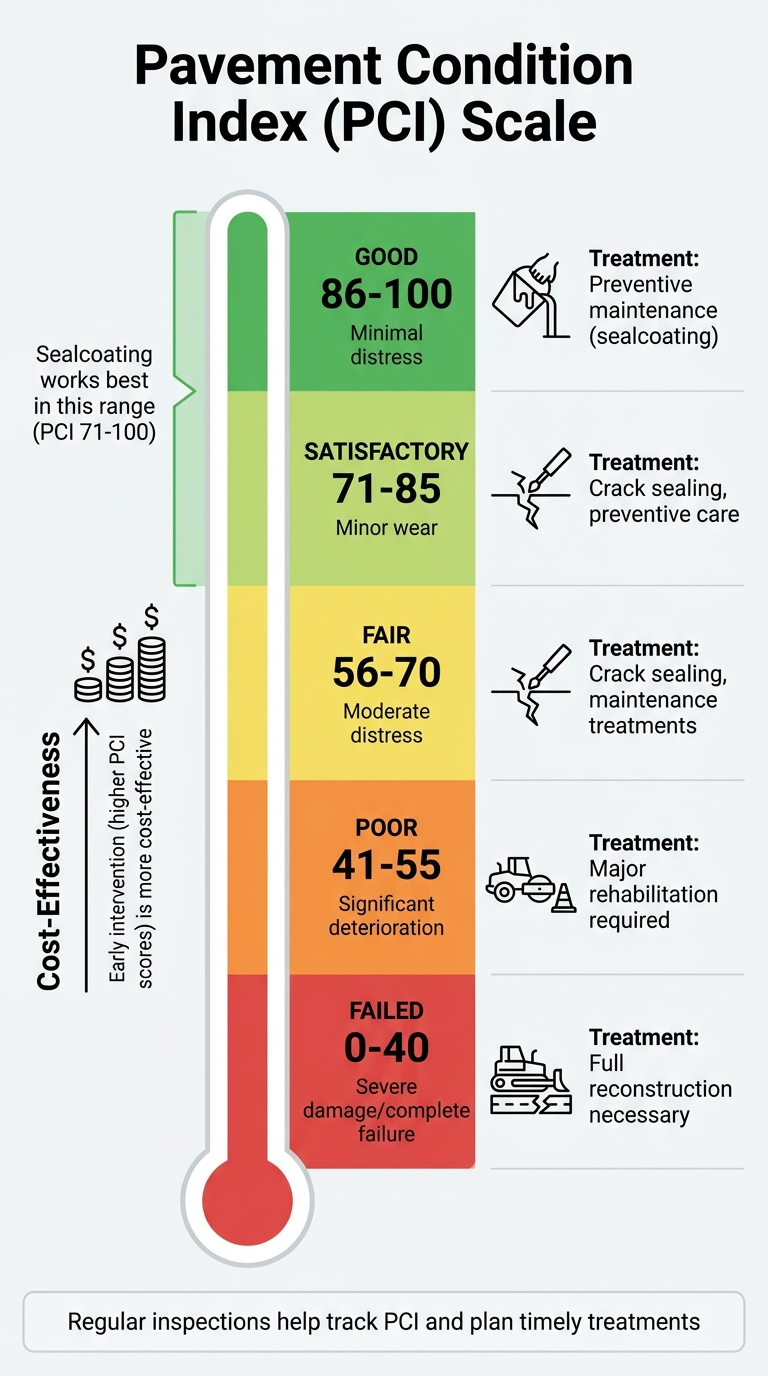
Pavement Condition Index (PCI) Scale and Treatment Recommendations
Managing pavement effectively begins with understanding what paved assets you have and their current condition. Without a clear inventory and regular evaluations, you're more likely to find yourself reacting to problems instead of preventing them. Accurate records and inspections are the foundation for transitioning from reactive fixes to proactive, long-term management.
Creating a Pavement Inventory
Start by documenting every paved surface on your property - this includes parking lots, driveways, pathways, and alleys. Capture essential details like GPS-based location, dimensions, pavement type, and maintenance history.
For larger properties, break the pavement into sample units of about 5,000 square feet. Group these units based on their function: for example, high-traffic loading zones will likely need a different approach than light-traffic pathways. To maintain consistency, follow the ASTM D6433 methodology for parking lot assessments. If your property is extensive, you don't need to inspect every square foot. In systems with 40 or more sample units, inspecting a representative 10% can provide a reliable snapshot of overall conditions. Scheduling inspections every two to four years helps track how quickly the pavement is deteriorating.
This inventory becomes the foundation for ongoing condition assessments.
Assessing Pavement Condition
After completing your inventory, evaluate the condition of each section through visual inspections. Look for common issues like alligator cracking, rutting, potholes, weathering, or bitumen bleeding.
The Pavement Condition Index (PCI) is a standard metric used to measure pavement quality. This scale ranges from 0 to 100, with 100 representing perfect condition and 0 indicating complete failure. For example, a PCI score between 86 and 100 reflects "Good" condition with minimal distress, while a score between 41 and 55 indicates "Poor" condition, likely requiring significant rehabilitation.
"A Pavement Management Program (PMP) is a decision-making tool employed to assess and track existing and historical pavement condition, and it is used to make cost-effective decisions about pavement maintenance and rehabilitation treatments." - Stanislaus Council of Governments
Understanding the condition of your pavement is key to selecting the right treatment. For surfaces in "Fair" or "Satisfactory" condition, maintenance steps like crack sealing can be effective. However, when defects become widespread, more extensive rehabilitation or even full reconstruction may be necessary. Properties with heavy commercial traffic may benefit from additional tools, such as a Falling Weight Deflectometer (FWD), to evaluate structural capacity and estimate remaining service life. These assessments help ensure timely and cost-efficient decisions for pavement upkeep.
sbb-itb-bfcbd36
Maintenance and Repair Methods
Once you've assessed the condition of your pavement, it's time to use targeted treatments to maintain and extend its lifespan. A well-planned program that includes crack filling, asphalt repair, and sealcoating can help protect surfaces and prevent small problems from turning into expensive repairs. These preventative measures can delay the need for major reconstruction and keep your pavement in better shape for longer. Below are specific methods for sealcoating, crack filling, pothole repair, and ensuring ADA compliance.
Sealcoating: Protection and Timing
Sealcoating is an important step in shielding asphalt from weather, UV rays, and water. It works best when applied to pavement that is still in good condition, typically when the Pavement Condition Index (PCI) is between 71 and 100. However, sealcoating won't fix structural damage if it's delayed too long. After completing any asphalt repairs, wait at least 90 days before sealcoating. This allows the new asphalt to cure fully and ensures petroleum oils have evaporated.
Crack Filling and Pothole Repair
Crack sealing is one of the most effective preventative measures available. It prevents water from getting into the pavement base, which can lead to structural damage over time. Cracks that are between 1/4 inch and 1/2 inch wide are ideal for filling, and the cost usually ranges from $1 to $3 per linear foot.
Potholes, on the other hand, need to be addressed quickly to avoid further damage. For smaller potholes under 2 square feet, repairs typically cost between $100 and $250 each. During inspections, you can use a "screwdriver test" to check the condition of cracks and edges. If the screwdriver penetrates more than 1 inch with little resistance, it could indicate damage to the pavement base, which may require a full-depth repair rather than a surface patch.
ADA Compliance and Safety Hazards
Regularly inspect sidewalks, curbs, and parking areas to identify safety hazards and ensure they meet ADA standards. Accessible surfaces should be stable, firm, and slip-resistant to accommodate mobility devices. Vertical changes of up to 1/4 inch are acceptable without treatment, but changes between 1/4 inch and 1/2 inch must be beveled at a slope no steeper than 1:2.
When repairing patches or utility cuts, make sure any height differences between new and existing pavement meet ADA guidelines. Parking spaces and adjacent access aisles should have surface slopes of no more than 2% in any direction. After repairs, check slopes again to account for settling or frost heaves. Additionally, drainage grates must not allow the passage of a 1/2 inch diameter sphere, and elongated openings should be oriented perpendicular to the main direction of travel to prevent wheelchair casters from getting stuck.
Failure to comply with ADA standards can result in civil penalties of up to $75,000 for a first violation and $150,000 for repeat offenses. By following these safety measures, you can improve the usability, safety, and compliance of your pavement.
Building a Long-Term Maintenance Plan
Creating a long-term maintenance plan starts with compiling a detailed inventory of your pavement assets. This inventory should include essential details like the location, age, and condition of all paved surfaces. Regular condition assessments, often using the Pavement Condition Index (PCI), can help you gauge current distress levels and estimate how much service life remains.
A Pavement Management System (PMS) uses this data to predict future deterioration, set project priorities, and create accurate forecasts for repair schedules and budgets. The guiding principle here is applying the "right treatment at the right time" to avoid expensive reconstruction down the line.
"Pavement management is the process of planning the maintenance and repair of a network of roadways or other paved facilities to optimize pavement conditions over the network"
By leveraging this data, you can proactively schedule maintenance and extend the lifespan of your pavement.
Scheduling Preventive Maintenance
Regular visual inspections are crucial for keeping condition data up to date and planning preventive treatments. High-traffic areas should be inspected every two years, while low-traffic areas can be assessed every four years. Using the ASTM D6433 standard ensures that these assessments are both consistent and reliable.
Preventive treatments, such as crack sealing and micro-surfacing, are most effective when applied early in a pavement’s life cycle - before significant wear and tear occur. As pavement ages, existing issues can lead to new problems at a faster rate. Annual preventive treatments based on these condition assessments can help you avoid the much higher costs associated with major repairs or full reconstruction.
Choosing the Right Treatment
Once you have updated condition data, you can evaluate the most cost-effective treatment options. For minor defects, maintenance treatments like crack filling can slow further wear, while rehabilitation treatments such as overlays can significantly improve conditions when damage is more severe.
To make informed decisions, conduct a Life Cycle Cost Analysis (LCCA) over periods like 20, 40, or 50 years. This analysis should include initial construction costs, ongoing maintenance, rehabilitation expenses, and salvage value. For instance, while a Stone Matrix Asphalt (SMA) surface may cost about 20% more than a dense-graded Hot Mix Asphalt (HMA), it could extend the pavement's lifespan by up to 40%. Additionally, consider "user costs" like vehicle operating expenses and traffic delays to fully understand the economic impact of different maintenance schedules.
Conclusion
Taking care of pavement as a long-term asset is a smart way to safeguard your property investment. Rather than waiting for issues to arise, a proactive approach with data-driven, scheduled maintenance can help ensure safety and better control over costs. As Magdy Mikhail, PhD, PE, Director of Transportation Industry Solutions at AgileAssets, puts it: "Modern pavement management is a more holistic approach that lets agencies deliver safer, longer-lasting pavements while saving money in the near term and into the future".
For example, regular sealcoating every three to five years can extend the life of pavement from 10–15 years to as much as 20–30 years. In commercial settings, spending around $1,200 on preventive care can help avoid replacement costs that could reach up to $15,000. By making these modest investments, property owners not only save money but also reduce liability risks and improve the overall appearance of their property.
This preventive care goes beyond cost savings - it enhances safety by reducing trip hazards and contributes to a polished, professional image. Well-maintained pavement sends a message of responsible property management, helping to preserve property value while ensuring budget stability and public safety. It's a forward-thinking approach that prepares you to meet future challenges with confidence.
FAQs
How do I start a pavement inventory if I have multiple lots?
To start a pavement inventory for multiple lots, examine the condition of each lot separately. Pay attention to factors such as surface distress, visible cracks, and the overall state of the pavement. Keep detailed records for every lot, noting these observations clearly. Use this information to create a pavement management plan that prioritizes maintenance tasks. Taking this organized approach allows you to monitor changes over time, schedule repairs effectively, and help prolong the lifespan of the pavement across all your properties.
What PCI score means it’s time to overlay or replace pavement?
A PCI score (Pavement Condition Index) of 70 or below suggests it’s time to think about an overlay or even full replacement. When the score falls between 56 and 70, it often means the pavement requires some level of rehabilitation or reconstruction. Performing regular assessments is key to deciding the right steps to keep the pavement functional and preserve its value.
What maintenance plan gives the best ROI for my property?
A preventive maintenance plan offers the most cost-effective way to care for your pavement. By scheduling regular inspections and addressing issues like sealcoating and crack sealing promptly, you can cut repair costs by as much as 30%. This strategy also helps extend the pavement's lifespan by roughly 20%.
Preventive maintenance isn't just about saving money - it slows down wear and tear, minimizes the need for costly repairs, and helps maintain the overall value of your property. Plus, well-maintained pavement can improve tenant satisfaction, making it a smart investment for property owners.
Need parking lot maintenance?
Contact us today for a free proposal on your next pavement project.
Get Your Free Proposal