
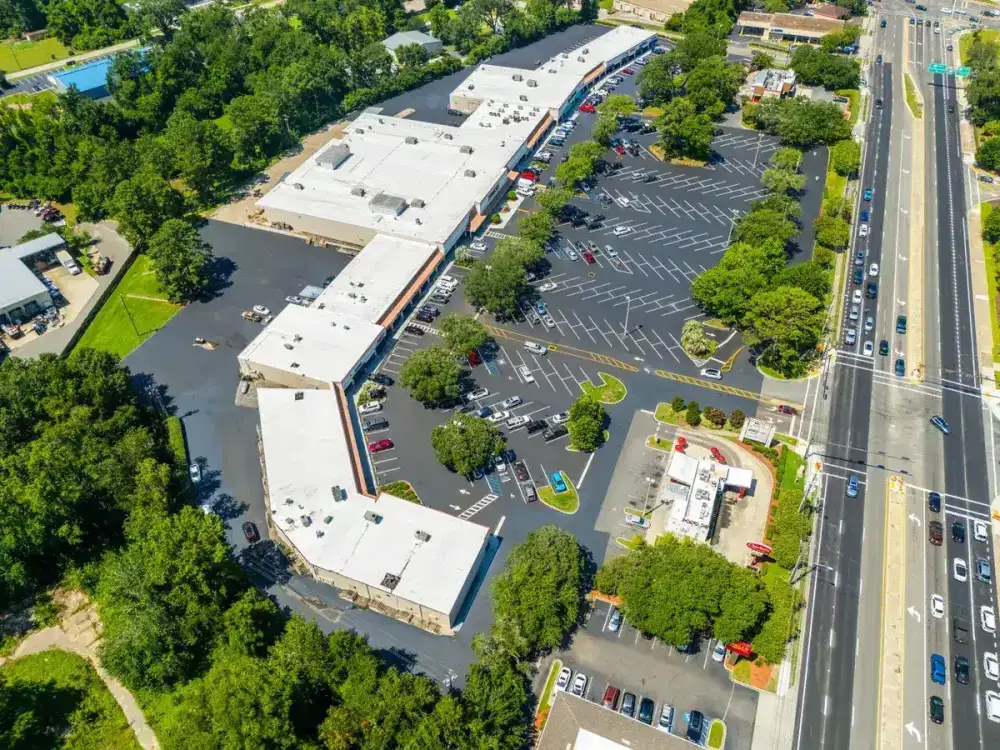
In the world of asphalt maintenance, longevity is the primary concern for any property owner. Assuming a contractor correctly applies the material, a residential driveway can stay dark for five years, while a busy commercial lot often shows wear paths much sooner.
When it comes to the life of a professional sealcoat job, two rules of physics and chemistry own the outcome: “More is Better” and “Less is Better.”
Rule #1: More is Better (The Cure)
Sealer doesn’t just dry—it cures. This is a process of coalescence, where the water evaporates and the asphalt particles fuse into a single, hardened protective layer.
- The Residential Advantage: Homeowners can often park on the street for three or four days. That extended window allows the material to reach its absolute maximum structural density before it ever sees a tire.
- The Commercial Reality: Business logic usually dictates a 24-hour turnaround. While a minimum 24 hours is a professional standard that allows for a safe reopening, the chemical “toughening” process actually continues for another 24 hours. Because a commercial lot starts working the moment we pull the cones, we use a higher-tier mix design to protect the sealer during that final curing stage.
- The Tallahassee Factor: In our North Florida humidity, curing can be slower. We insist on that 24-hour minimum because every hour of initial cure time is “money in the bank” for the longevity of the sealer.
Rule #2: Less is Better (The Traffic)
The “Less is Better” rule is where the driveway and the parking lot truly go their separate ways. It boils down to two factors: Weight and Friction.
- Weight: A driveway handles family cars. A commercial lot handles high-volume traffic and heavy rigs. While the sealer protects the surface from UV oxidation, these heavy loads flex the pavement, testing the bond of everything from the sealer to the base.
- Friction: On a driveway, you mostly pull in and out in a straight line. In a parking lot, you have constant “power steering stress.” When a heavy vehicle turns its wheels while standing still, it acts like 40-grit sandpaper grinding against the surface.
Managing the Balance: The GoSITE™ Advantage
At American Curb Appeal, our GoSITE™ process is about doing what we can for both the customer and the chemistry:
- High-Solids Mix: We don’t rely on overly-marketed “quick-dry” additives. We use a commercial-grade, high-solids mix design engineered to resist shear stress and friction during that critical 48-hour curing window.
- Smart Phasing: We work in sections to ensure every square foot gets a minimum of 24 hours of undisturbed cure time before reopening.
- Honest Assessment: If the lot is too far gone for sealer to bond properly, we’ll tell you. Our reputation for integrity here in Tallahassee and the Big Bend is stronger than our mix design.
Summary: Why Sealer on Parking Lots Wears Sooner than on Driveways
- Immediate Workload: Commercial lots go to work at the 24-hour mark, while the chemical bond is still reaching full toughness.
- High Friction: “Power steering stress” from stationary turns grinds the sealer away in high-traffic bays.
- Heavy Load: Frequent truck traffic flexes the pavement, putting more stress on the sealcoat bond than residential vehicles.
Call us for a GoSITE™ Assessment.
Direct and Honest. Our Blueprint Standard.
Need parking lot maintenance?
Contact us today for a free proposal on your next pavement project.
Get Your Free Proposal