
The cheapest pavement budget is the one built in the right order, because every dollar you spend on water control reduces what you have to spend on structural repair later. Budget season is the one time of year you get to be proactive instead of reactive. If you are a property manager in Monticello putting numbers together for 2027, the sequence of work matters as much as the scope.
Here's the short version:
- Seal the cracks first. Water reaching the limerock base is what turns a cosmetic problem into a structural one.
- Sealcoat after the cracks are closed, not before. Sealer is a protective skin, not a filler.
- Stripe last, so you are not painting over work that still has to happen.
- Budget full depth repair only where the base has actually failed, not everywhere the surface looks tired.
- Put the whole thing on a repeating multi year cycle so the owner sees a plan, not a surprise.
Why Budget Order Matters More Than Budget Size
Most pavement budgets I see get built backwards. Someone walks the lot, sees faded lines and a few potholes, and asks for striping and patching. The cracks get skipped because they are an easy maintenance item to skip. Then the next heavy North Florida rain pushes water straight through those cracks into the limerock base, the base loses its ability to support vehicle weight, and the following year the owner is looking at alligator cracking and new potholes in places that looked fine.
That is the whole mechanism of premature pavement failure, and it is almost entirely preventable. When you fund crack sealing first, you are closing the path water uses to get under your asphalt. Everything else you spend money on lasts longer because the base underneath stayed dry. So build the 2027 line item as a sequence of dependencies rather than a shopping list.
The Maintenance Order That Saves the Most Money
Step one, crack sealing
This is the first dollar in the budget. Our crews mechanically clean the joint with wire brushes and clear it with high velocity blowers, because if the sidewalls are not bone dry and free of vegetation, the bond will not hold. Then hot applied rubber goes in, engineered to stay flexible through our temperature swings. If you want the longer explanation of what water does once it gets below the surface, our article on why water damages your pavement foundation covers it. Budget this as Asphalt Crack Repair and treat it as non optional.
Step two, structural repair where the base has failed
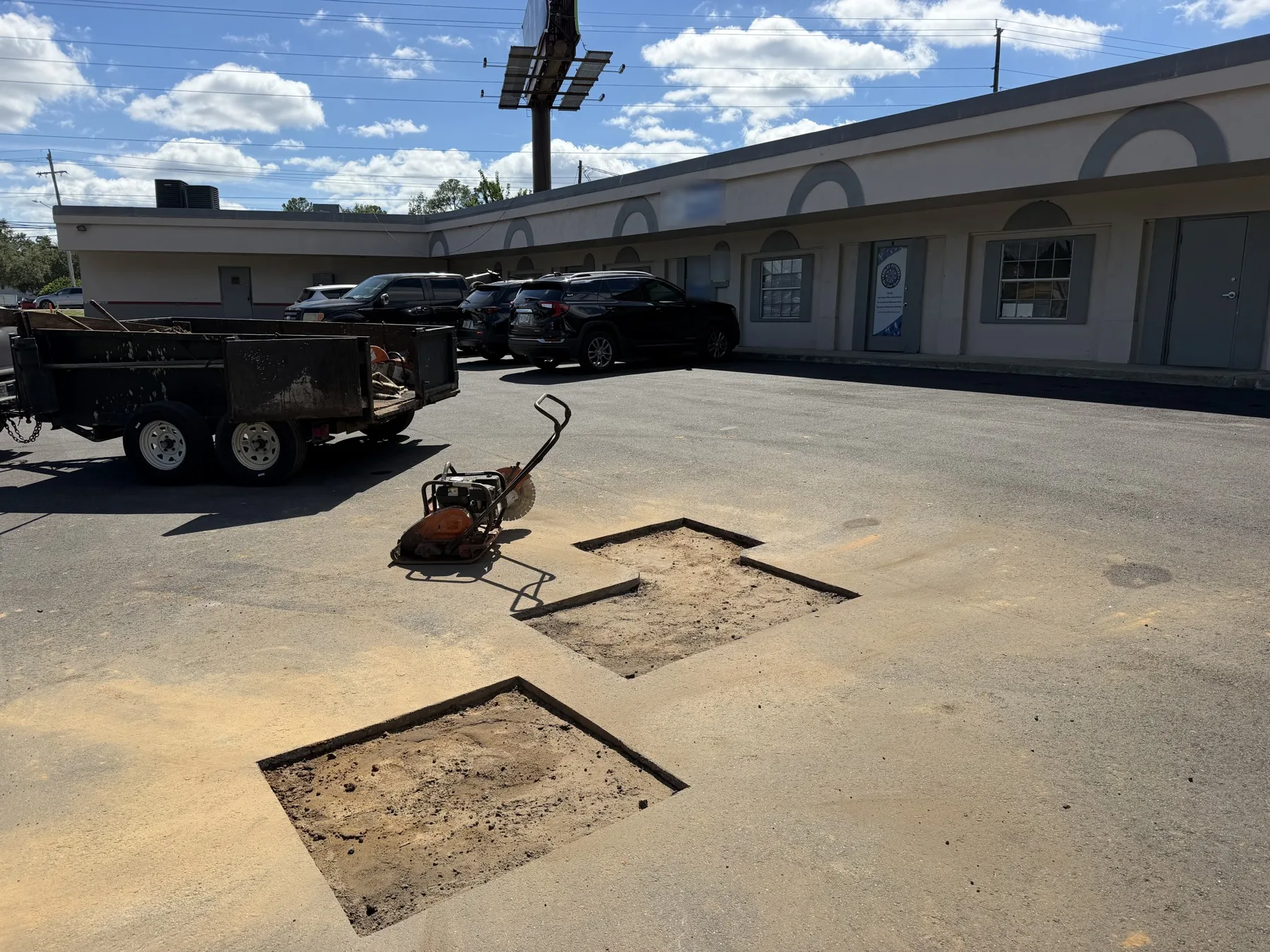
Not every bad looking area needs excavation. Most lots we look at do not need replacing, which is the whole reason this company exists. If the surface is cracked or dull or has isolated potholes but the pavement is still solid underfoot, that is a repair and preservation job. Where the base has gone soft, we remove the failed asphalt down to the base material and excavate the edges so a full thickness of asphalt is achieved, then bond the new hot mix to the old with professional grade liquid asphalt tack. That is Asphalt Restoration & Structural Repair, and it is the line item most worth getting mapped accurately before you price it.
Step three, sealcoating
Sealcoating does not fix cracks. It is a protective skin that shields the surface from UV oxidation, water intrusion and chemical spills. It belongs after the cracks are sealed and the failed areas are patched, so you are coating a surface that is actually intact. If the lot is new asphalt, we typically recommend waiting 6 to 12 months before the first application so the pavement can release its light oils and the sealer can form a permanent bond.
Step four, striping
Paint goes on last. Striping over asphalt that is about to be patched or sealed is money spent twice. It is also the step where layout decisions get made, so it is the right moment to address stall counts, traffic flow and accessibility.
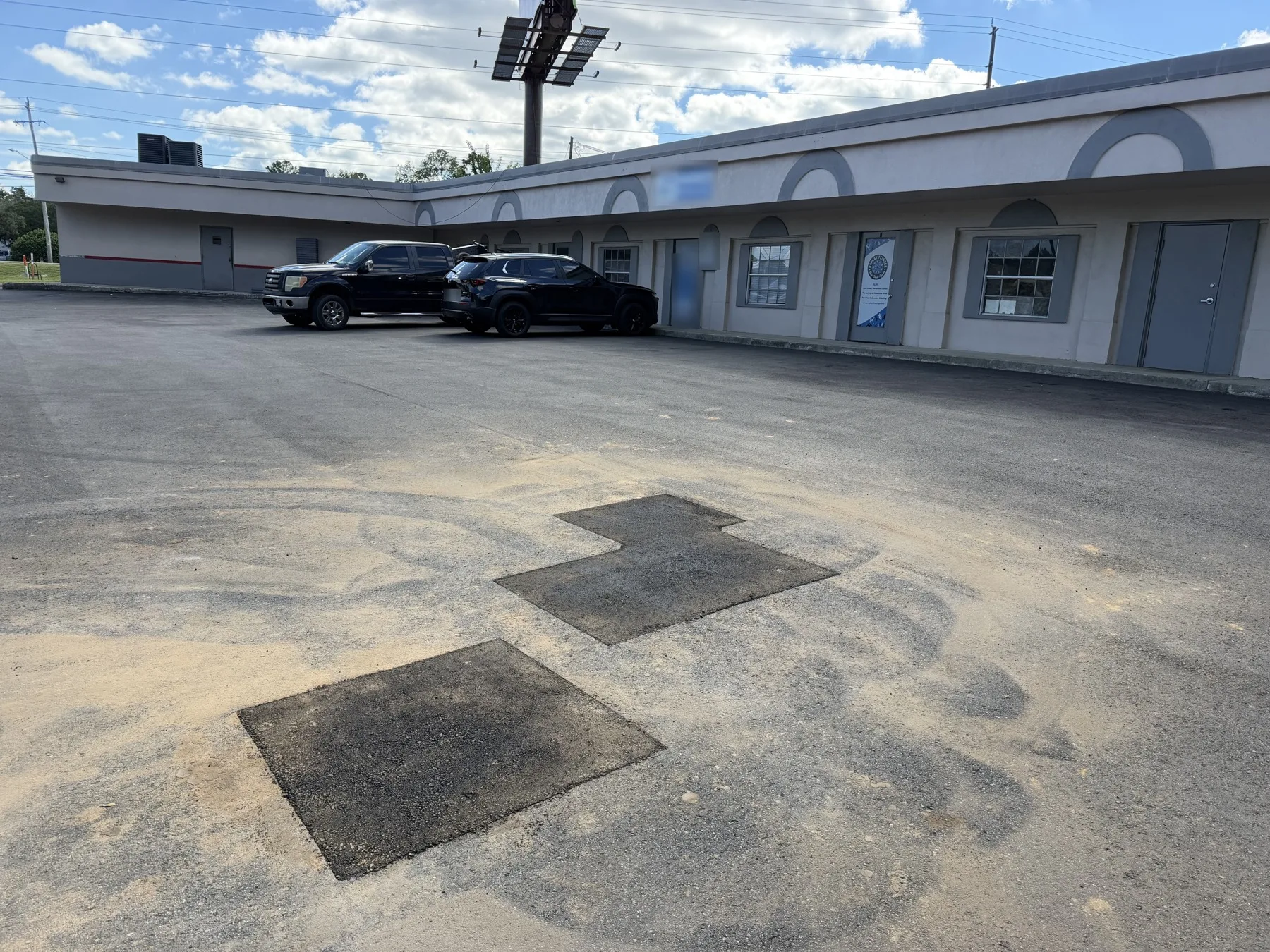
A commercial lot with sealed cracks and fresh striping, photographed after the full maintenance sequence was completed in order.
Building a Multi Year Cycle for a Monticello Property
A single year budget invites reaction. A cycle invites planning. The work that protects the pavement repeats on a short interval, and the work that changes the pavement happens on a longer one.
| Line item | How often it recurs | What happens if you defer it |
|---|---|---|
| Crack sealing | Recurring, as new cracks open | Water reaches the limerock base, subgrade softens, potholes form |
| Sealcoating | On a preservation interval | UV oxidation continues, surface dries out and ravels |
| Striping | After each sealcoat, or when markings fade | Faded lines, lost capacity, accessibility exposure |
| Full depth repair | As needed where base has failed | Failure spreads outward from the soft area |
| Concrete and curb repair | As needed | Broken curbs let water undermine adjacent asphalt |
| ADA stall and path of travel work | When layout or surfaces change | Ongoing liability exposure |
For a Monticello property, that usually means one preservation year and one lighter year, repeating. In the preservation year you fund crack sealing, any mapped full depth repair, High-Performance Sealcoating & Preservation and a full restripe. In the lighter year you fund crack sealing again plus whatever isolated repair the walk turned up. If you are already dealing with potholes going into budget season, our guide to pothole repair for Monticello commercial properties explains what a proper repair involves so you can price it honestly rather than guessing.
Do not forget the concrete. Broken curbs are not just an eyesore. They allow water to undermine your asphalt, which puts them in the same category as cracks. Heaved or cracked sidewalk panels and trip hazards belong in the same conversation, because that liability compounds.
What to Document So an Owner or Board Approves the Line Item
Owners and boards approve what they can see. Vague requests for parking lot maintenance get tabled.
Get a written scope with the work broken out. For commercial properties we put the numbers in writing with the scope separated, so you can see what is being striped, what is being brought up to ADA code and what is optional, rather than one lump figure. That separation lets you present a base recommendation and an optional tier, which is how most boards actually make decisions.
Get the whole surface mapped, not just the obvious spots. For a large lot or a community with private roads we walk the entire surface first and map every failed area, every low spot that holds water and every edge that is breaking up. Edge failure in particular is one of the most common things we are called out for, because pavement edges have no shoulder holding them in place.
Document the accessibility items separately. In Florida, parking lot accessibility is a primary target for litigation, and the requirements go beyond federal standards with specific blue and white signage and no parking markings in access aisles. We execute the Florida mandated 12 foot wide parking space with a 5 foot wide hatched access aisle, and we correct slopes, because a slope exceeding 2 percent in any direction turns a parking space into a compliance problem. Pricing ADA & Florida Accessibility Compliance as its own line gives the owner a clear picture of what is a legal requirement and what is discretionary.
Getting Your 2027 Numbers From American Curb Appeal
We have specialized exclusively in the lifecycle management of existing commercial pavement since 1998, and we serve Monticello along with the rest of the Tallahassee region. If you want a bid for next year's budget, call or send a request through the site and we will come walk the lot. You can see how we work with property managers and commercial owners or reach us at (850) 545-1776.
FAQs
Should I budget to repair my lot or replace it?
Most lots we look at do not need replacing. If the surface is cracked, dull or has isolated potholes but the pavement is still solid underfoot, that is a repair and preservation job. The signal that changes the answer is widespread base failure, which is why we map the surface before quoting.
Can I just sealcoat and skip the crack sealing to save money?
No, and this is the most expensive shortcut in pavement maintenance. Sealcoating is a protective skin, not a structural filler. Unsealed cracks let water bypass the asphalt and saturate the limerock base, which leads to subgrade softening and potholes under a brand new coat of sealer.
How do I get a bid I can actually present to an owner?
Call or send the request through the site and we will come walk the lot. For commercial properties we put the numbers in writing with the scope broken out, so you can see what is being striped, what is being brought up to ADA code and what is optional, rather than one lump number.
My lot was paved recently. What goes in the budget for it?
New asphalt needs time to cure and release its light oils, so in our North Florida climate we typically recommend waiting 6 to 12 months before the first sealcoat application. In the meantime, budget crack sealing as cracks appear and keep an eye on the edges, since those fail first.
Do you handle the concrete work in the same budget?
Yes. Our concrete crews pour new work every week, including driveway extensions, aprons, sidewalks, dumpster pads, equipment pads and ADA ramps, and we repair heaved sidewalk panels and damaged curbing. What we do not do is new asphalt paving.
Need parking lot maintenance?
Contact us today for a free proposal on your next pavement project.
Get Your Free Proposal