
How Often a Commercial Parking Lot in Tallahassee Should Be Restriped
I would not set restriping by the calendar alone. In many cases, a Tallahassee parking lot should be restriped when drivers can no longer read the lines, arrows, crosswalks, or accessible markings from the driver’s seat.
Here’s the short answer:
- I’d inspect the lot at least once a year
- I’d check high-wear areas first, like turns, stall entrances, and stop-and-go paths
- I’d move faster on safety markings, such as crosswalks, fire lanes, and accessible spaces
- I’d factor in Tallahassee sun, rain, and pavement wear
- I’d handle surface work in the right order: repair, sealcoat, then restripe
A faded lot can lead to crooked parking, missed arrows, blocked access aisles, and weaker traffic flow. And if the asphalt is cracked, patched, or freshly sealcoated, that can change when restriping should happen.
What matters most is simple: if key markings are hard to see, it’s time to repaint them.
Set a restriping schedule based on traffic and wear
Traffic volume and turning patterns play a big role in how fast parking lot striping and markings fade. That means your restriping schedule should match how the lot is used, not just the calendar.
A busy lot with frequent turns, stop-and-go movement, and steady daily use will often wear markings down sooner. A quieter property may go longer between touch-ups. Either way, the smartest move is to watch the spots that tend to fade first.
High-traffic lots fade faster
Heavier daily traffic wears markings down faster, especially in turning lanes and at stall entrances.
These areas take more friction from tires, braking, and repeated turning. If drivers are constantly cutting through the same path, the paint can wear out much sooner than the rest of the lot.
Moderate- and lower-traffic properties may last longer
Lower-traffic lots usually hold markings longer, but they still need regular checks.
It’s easy to assume a quieter lot can be left alone for long stretches. In many cases, that’s not the best call. Sun, weather, and normal vehicle movement can still wear lines over time, even when traffic is lighter.
The first areas where fading typically appears
After traffic volume, look at wear hotspots. Wear shows up fastest in turning areas and other high-friction spots. Inspect those areas first to judge the rest of the lot.
Think of these spots as your early warning signs. If the markings are fading there, the rest of the lot may not be far behind.
sbb-itb-bfcbd36
Inspect the markings that matter most
Use those worn areas as a guide for a closer look at the markings drivers and pedestrians depend on every day.
Check stall lines, arrows, crosswalks, and drive aisles
Start with the Tallahassee parking lot maintenance markings that shape day-to-day traffic flow: parking stall lines, directional arrows, drive aisles, pedestrian crosswalks, fire lanes, loading zones, and no-parking zones.
As you walk the lot, look for broken edges, thin paint, patchy coverage, and arrows that are tough to read from the driver’s seat. When markings start to fade, people may park at odd angles, miss traffic direction, or take up more space than they should.
Review accessible parking symbols and access aisles
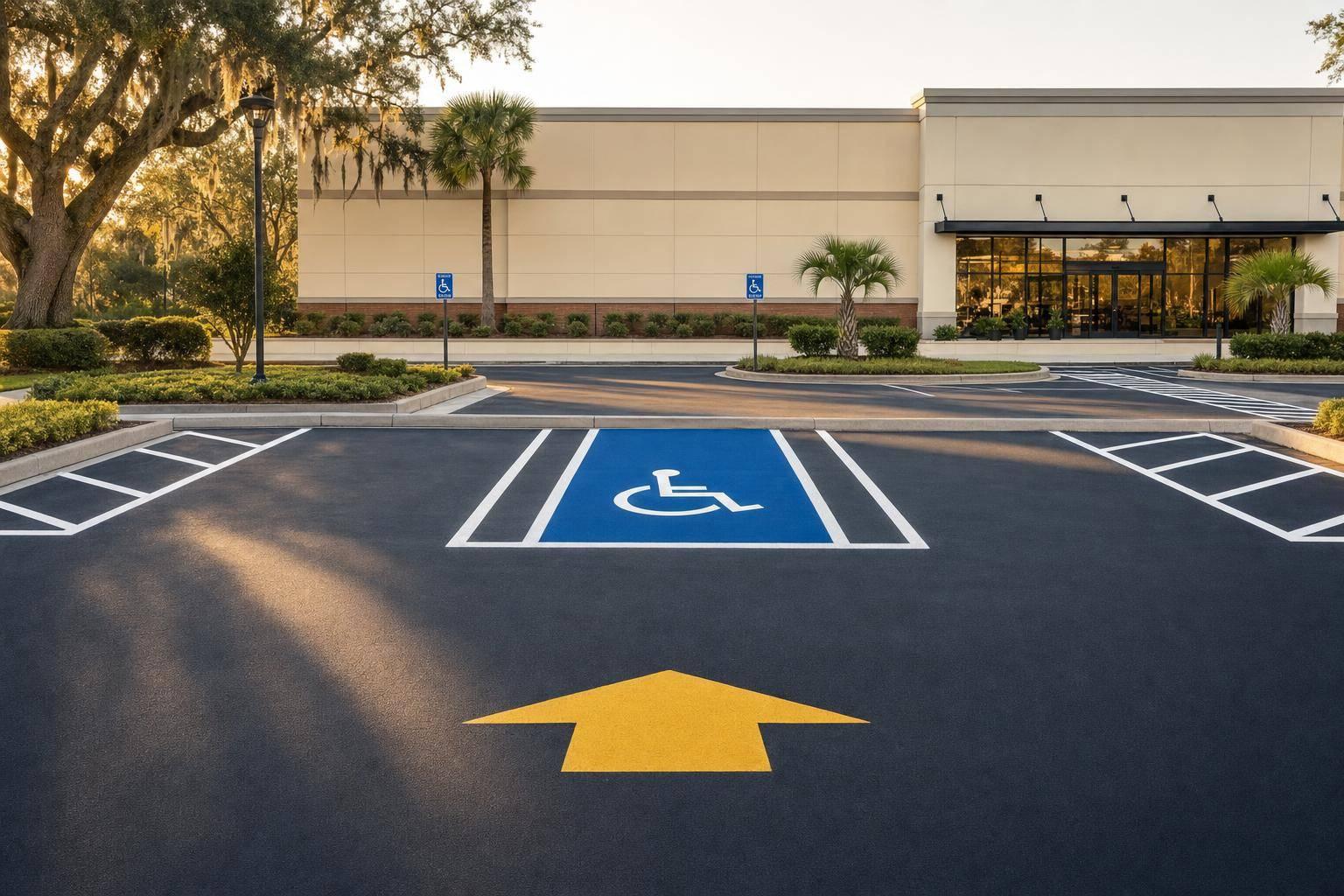
Accessible parking markings should get a close check every time. That includes the International Symbol of Accessibility (ISA), access aisle hatching, and van-accessible labels. If the blue-and-white contrast has faded or the “van accessible” text is hard to read, those spaces may need repainting.
During the same walk-through, check that accessible symbols, access aisle hatching, and van-accessible labels are clear and not blocked. It also helps to review safety and ADA-related markings before deciding what to repaint first.
| Marking Type | What to Inspect | Warning Signs |
|---|---|---|
| Parking stalls | Stall lines, end caps, loading zones | Vehicles straddling lines, crooked parking |
| Traffic flow | Directional arrows, lane lines, stop bars, no-parking zones | Drivers ignoring routes, bottlenecks at entrances |
| Pedestrian safety | Crosswalks, walkways, yield messages | Faded high-contrast stripes |
| ADA compliance | ISA symbols, access aisle hatching, van designations | Faded blue-and-white contrast, missing "van accessible" text |
| Emergency access | Fire lane curbs, "Fire Lane" lettering, signage | Faded red curb paint, obstructed lanes, missing signs |
Adjust your plan for Tallahassee weather, pavement condition, and sealcoating
Traffic isn't the only thing that wears down parking lot striping. In Tallahassee, strong sun and heavy rain can shorten the life of markings, so it's smart to check them often and restripe before they get hard to see.
The condition of the asphalt matters too. Cracked, rough, or patched pavement can wear markings down faster and make the finished lines look uneven. Milled surfaces usually need temporary markings until final paving is done. If the pavement is damaged, repair it before restriping.
Restripe after repairs, layout changes, or surface restoration
Any time the pavement is patched, resurfaced, or changed, take another look at the markings. Big repairs can shift the surface shape, and layout changes may mean stall lines, drive aisles, or ADA spaces need to move. Restriping helps the layout fit the repaired surface.
Plan restriping after sealcoating, not before
Sealcoating covers existing markings, so restripe only after the sealer has cured. If you stripe first, those new markings will be covered and will need to be done again. That order helps keep the new striping from being covered or damaged.
Maintenance sequence table
| Maintenance Stage | Purpose | Marking-Related Work |
|---|---|---|
| 1. Inspection | Identify structural defects and ADA violations | Audit existing layout for compliance and visibility |
| 2. Pavement Repair | Fix potholes, seal cracks, and address surface damage | Re-evaluate layout if patches change surface geometry; apply temporary markings if needed |
| 3. Sealcoating | Protect asphalt from UV and water; restore dark color | Covers existing markings to provide a high-contrast base |
| 4. Curing | Allow sealer to harden and bond to the surface | No marking work |
| 5. Restriping | Restore safety, traffic flow, and legal compliance | Apply final markings |
Conclusion: Use a condition-based checklist to decide when to restripe
After you review the markings that matter most, use this checklist as the final call on whether restriping is due. The main idea is simple: go by the lot’s condition, not the calendar alone.
During inspections, check the markings drivers and pedestrians rely on every day:
- Stall lines
- Drive aisle arrows
- Crosswalks
- Accessible spaces
If high-wear areas are already fading, restripe those sections before the rest of the lot.
Use visible wear, not a fixed schedule, as the trigger for restriping. If the lot also needs surface work, get the order right: repair, sealcoat, then restripe.
Key takeaways for property managers and owners
Use a condition-based checklist and restripe sooner when key markings fade. Restripe sooner when crosswalks, accessible spaces, or drive aisle arrows fade. Fix pavement problems before restriping. Restripe only after sealcoating. After any repair or layout change, recheck every marking before reopening.
When visibility drops, restripe. When pavement changes, inspect again.
FAQs
How do I know if my lot needs restriping now?
Your lot may need restriping if the lines look faded, blurry, peeling, cracked, or tough to read. When markings start to disappear, drivers can park at odd angles or take up more than one space. That can cut into your lot’s usable capacity and make the space feel less organized.
American Curb Appeal Inc. recommends checking high-traffic areas every 18 to 24 months to help keep your lot safe, professional, and fully functional.
Which markings should be repainted first?
Repaint high-traffic markings first, especially ones that look faded, blurry, peeling, or hard to read. These areas often matter most for safety and can help you stay in line with local rules.
Also check that ADA-compliant markings and accessible stalls remain clearly marked. Clear striping supports safety and helps keep those spaces usable for the people who need them.
Should restriping wait until after sealcoating?
Yes. Restripe after sealcoating so the fresh, dark surface improves contrast and makes white and yellow markings easier to see.
American Curb Appeal Inc. often handles these services together to support proper pavement prep and better paint adhesion. That can cut down on touch-ups and help the lot look clean and well marked.
Need parking lot maintenance?
Contact us today for a free proposal on your next pavement project.
Get Your Free Proposal