
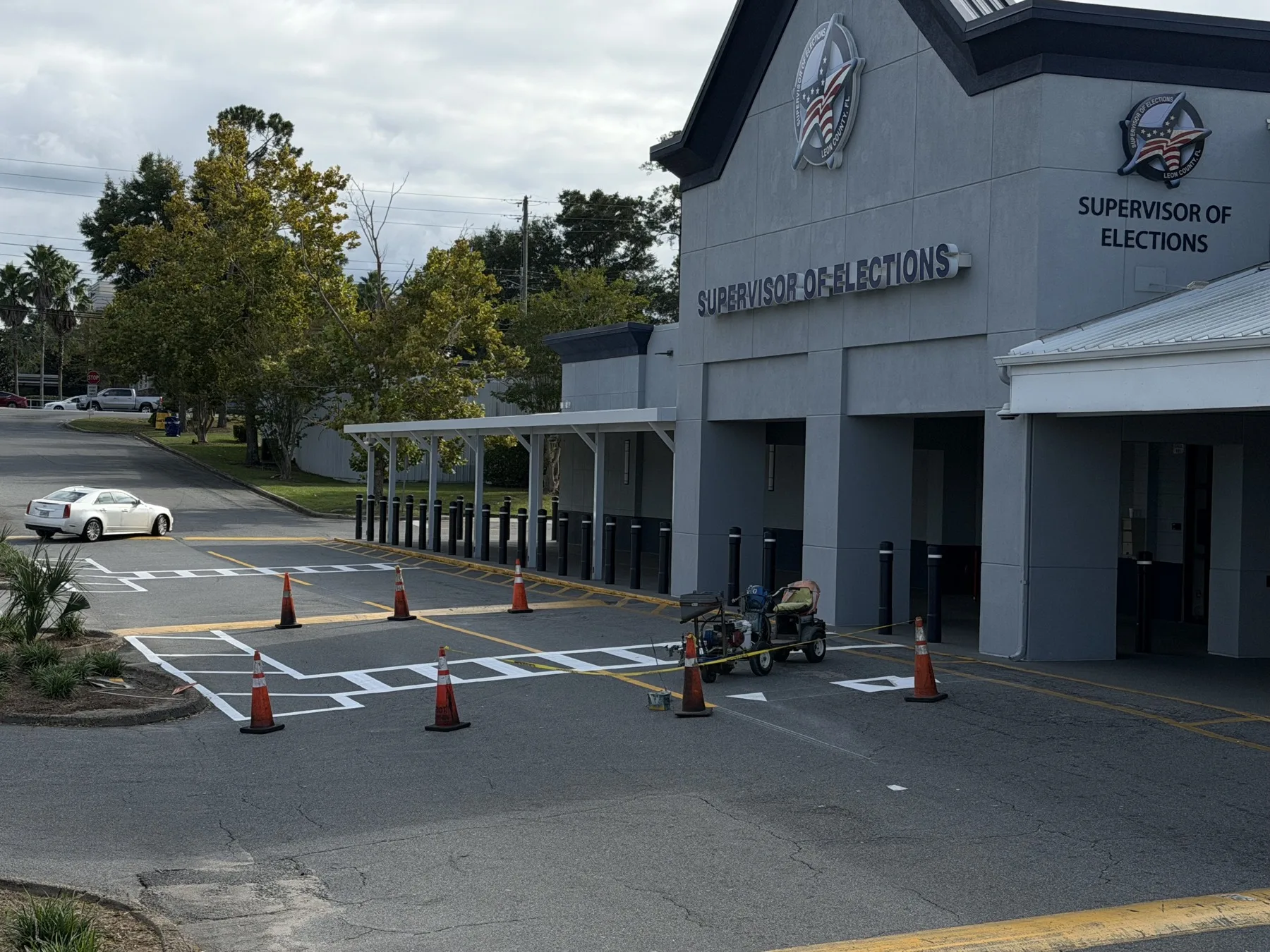
A new crosswalk gets painted the same way any good striping job gets done, by setting the layout on the pavement first, isolating the work area with cones and caution tape, and then running the bars with a line striping machine while the rest of the lot keeps working. In September 2026 we added zebra crosswalks with shark's teeth advance yield lines at the Leon County Supervisor of Elections at 2990-1 Apalachee Parkway in Tallahassee, ahead of the pedestrian traffic that comes with election season. The building could not close. That single constraint shapes almost every decision on a job like this.
Here's the short version:
- The crossing gets marked out on the pavement before any paint goes down, so the layout can be checked and adjusted while it is still erasable.
- The work area gets coned and taped off so drivers and pedestrians have a clear boundary and wet paint stays untouched.
- The bars are painted with a line striping machine for uniform edges and consistent material.
- Scheduling around the building's busy days matters as much as the paint itself.
What We Added at the Supervisor of Elections Lot
The scope was pedestrian safety markings: zebra crosswalks across the drive lanes, paired with shark's teeth advance yield lines set back ahead of the crossing.
A zebra crosswalk is the pattern of wide bars running parallel to the direction of travel. Drivers read it faster than two thin parallel lines because the pattern fills the field of view as they approach. Shark's teeth are the row of triangles painted on the approach, pointed back toward oncoming traffic. They tell a driver where to look and where to give way before the driver is already in the crossing.
For a public building, those two markings do a job no sign can do on its own. People arriving to vote, to drop paperwork, or to ask a question are often looking at the building, not the drive lane. The pavement markings put the instruction exactly where the driver's eyes already are. You can see the same principle at work in any lot where traffic and foot traffic share pavement, which is the point we made in how parking lot striping improves safety.
Layout Comes Before Paint
On this job the crossing was marked out on the pavement first. That is not a formality. It is the step that decides whether the finished crosswalk makes sense.
Before paint, a layout can be moved. After paint, it cannot, at least not cleanly. So we set the lines out and look at the result from a driver's seat and from a pedestrian's point of view. Does the crossing land where people actually walk, or where it looked good on paper. Does it connect to a curb cut or a walkway, or does it dump someone into a planter. Is the approach visible far enough back for the yield line to be useful. Does the new marking take parking stalls out of service that the property cannot spare.
We do not eyeball lines. We use the same mathematical layout techniques required on new commercial developments, which is how we keep bars uniform and square to the drive lane instead of drifting as they cross. That discipline comes from working new construction, where getting it right the first time matters because an inspector is going to look at it.
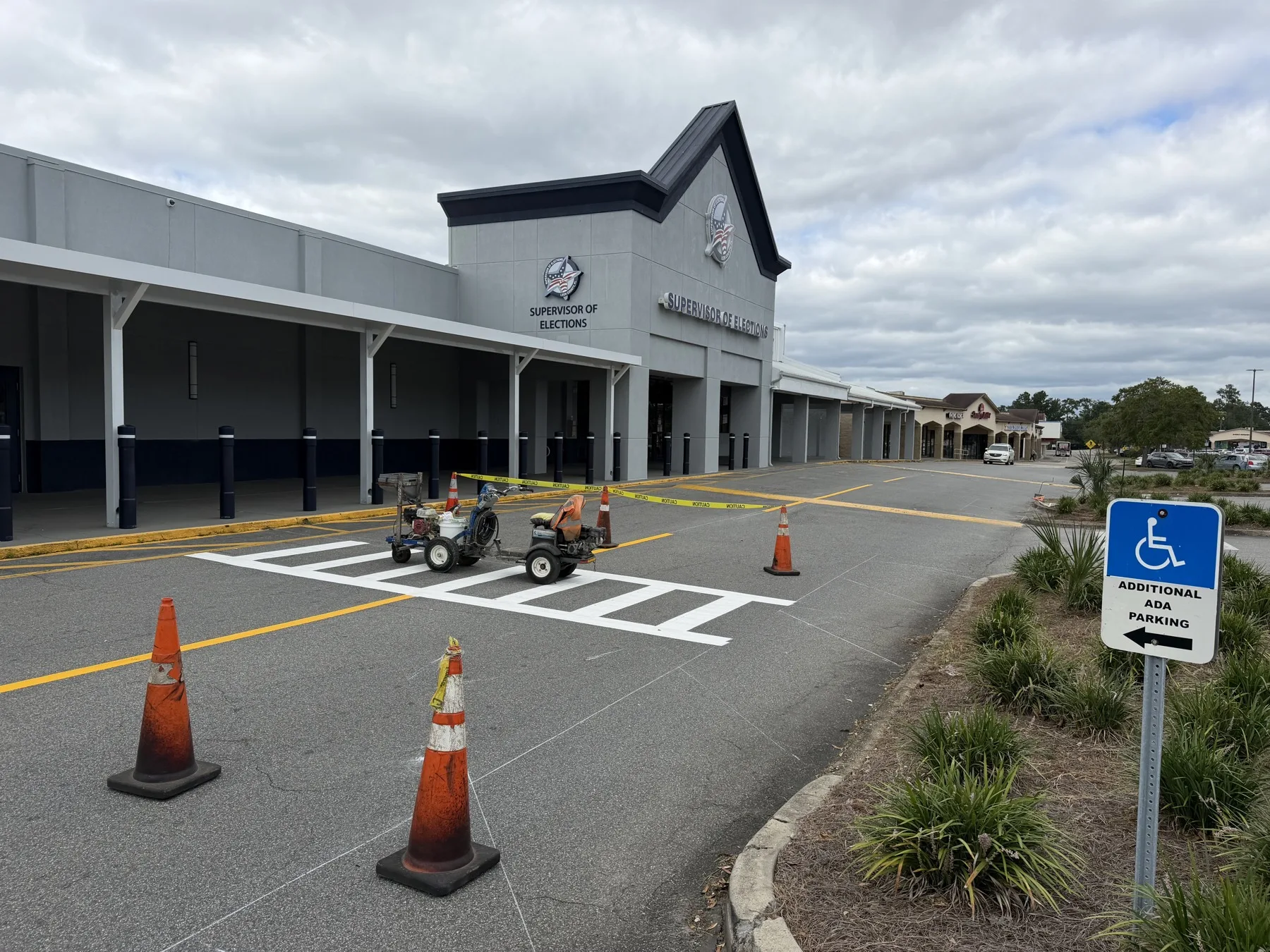
The work zone coned and taped off at the Supervisor of Elections lot while the rest of the parking area stayed open to the public.
Working a Lot That Cannot Close
A government office, a church, a school, and a medical office all share the same problem. The parking lot is part of the service. You cannot send people away for a day.
So we work in sections. On this job the area being striped was coned off and taped off with caution tape while the remainder of the lot stayed in use. The cones do two things at once. They keep tires off wet paint, which protects the finish and keeps tracked paint off the rest of the pavement. They also give pedestrians a visible edge to walk around, instead of leaving them to guess where the work ends.
Timing is the other half of it. We ask what the building's heavy days and heavy hours look like, then we fit the work into the quiet side of that schedule. For an elections office, the calendar is not a suggestion. For a church, it is Sunday. For a school, it is drop off and pickup. The marking plan does not change, but when we show up does.
Two ways to approach an occupied lot
| Approach | What it looks like | Best fit |
|---|---|---|
| Close the whole lot | All traffic diverted, crews move freely across the full surface | Vacant properties, weekend-only buildings, new construction before occupancy |
| Phase the work | Sections coned and taped in sequence, rest of lot stays open | Public buildings, offices, churches, schools, anywhere the doors have to stay open |
Most of the properties we stripe fall in the second row. That is normal, and it is planned for rather than worked around.
Where Crosswalks Fit Into the Bigger Picture
A crosswalk is rarely the only thing a lot needs. It is usually one piece of a pedestrian route that starts at a parking space and ends at the front door. That continuous, unobstructed route is the path of travel, and it has to be stable, firm, and slip-resistant, with no trip hazards or excessive slopes.
That is why crosswalk work often gets paired with other items. If the accessible stalls, hatched access aisles, or signage are not right, the crossing leads to a problem instead of away from one, and ADA & Florida Accessibility Compliance work belongs in the same scope. If a sidewalk panel at the end of the crossing has heaved, that is a Concrete Construction & Repair item, not a paint item. And if the pavement under the proposed crossing is cracking or breaking up, new paint on a failing surface is money spent twice.
The full project record for this job, including photos, is on our crosswalk striping project at the Supervisor of Elections.
Getting a Crosswalk Priced on Your Property
American Curb Appeal has been doing parking lot repair in the Tallahassee region since 1998, and striping has been part of that work for all 28 years. We serve Tallahassee, Crawfordville, Quincy, Havana, Monticello, Perry, Madison, Lake City, Apalachicola, and Live Oak.
If you want a number for crosswalks, yield lines, or a full restripe, call or send the request through the site and we will come walk the lot. For commercial properties we put the numbers in writing with the scope broken out, so you can see what is being striped, what is being brought up to ADA code, and what is optional, rather than one lump figure. Start with our Parking Lot Striping & Precision Layout page or call (850) 545-1776.
"American Curb Appeal does an incredible job at a very fair and competitive price. Terry is a great communicator, and his attention to detail is exceptional. Highly recommend this company for any asphalt needs." Noah C., Tallahassee
FAQs
Do you have to close my parking lot to paint a crosswalk?
No. We phase the work so only the active section is closed. On the Supervisor of Elections job the work area was coned off and taped off with caution tape while the rest of the lot stayed in use. We plan the sequence around your busiest days and hours.
Why mark the crossing out on the pavement before painting?
Because layout is the part you cannot undo. Marking it out first lets us confirm the crossing lines up with the walkway or curb cut, that the approach is visible far enough back, and that it is not taking stalls you need. Adjusting a layout mark takes a moment. Adjusting finished paint does not.
What are the triangles painted ahead of a crosswalk?
Those are shark's teeth, also called advance yield lines. They are set back from the crossing and pointed toward oncoming traffic to show drivers where to slow and give way before they reach the pedestrian area. They are commonly paired with a zebra crosswalk on properties with steady foot traffic.
Should pavement repairs happen before new striping?
Usually, yes. Paint sits on the surface, so if the asphalt under a proposed crossing is cracked or breaking up, the markings will go with it. We walk the surface first and flag anything that calls for Asphalt Restoration & Structural Repair so the striping goes onto pavement that will hold it.
How do we get a bid for striping our property?
Call or send the request through the site and we will come walk the lot. For commercial properties we put the scope in writing and break it out, so you can see what is being striped, what is being brought up to ADA code, and what is optional.
Need parking lot maintenance?
Contact us today for a free proposal on your next pavement project.
Get Your Free Proposal