
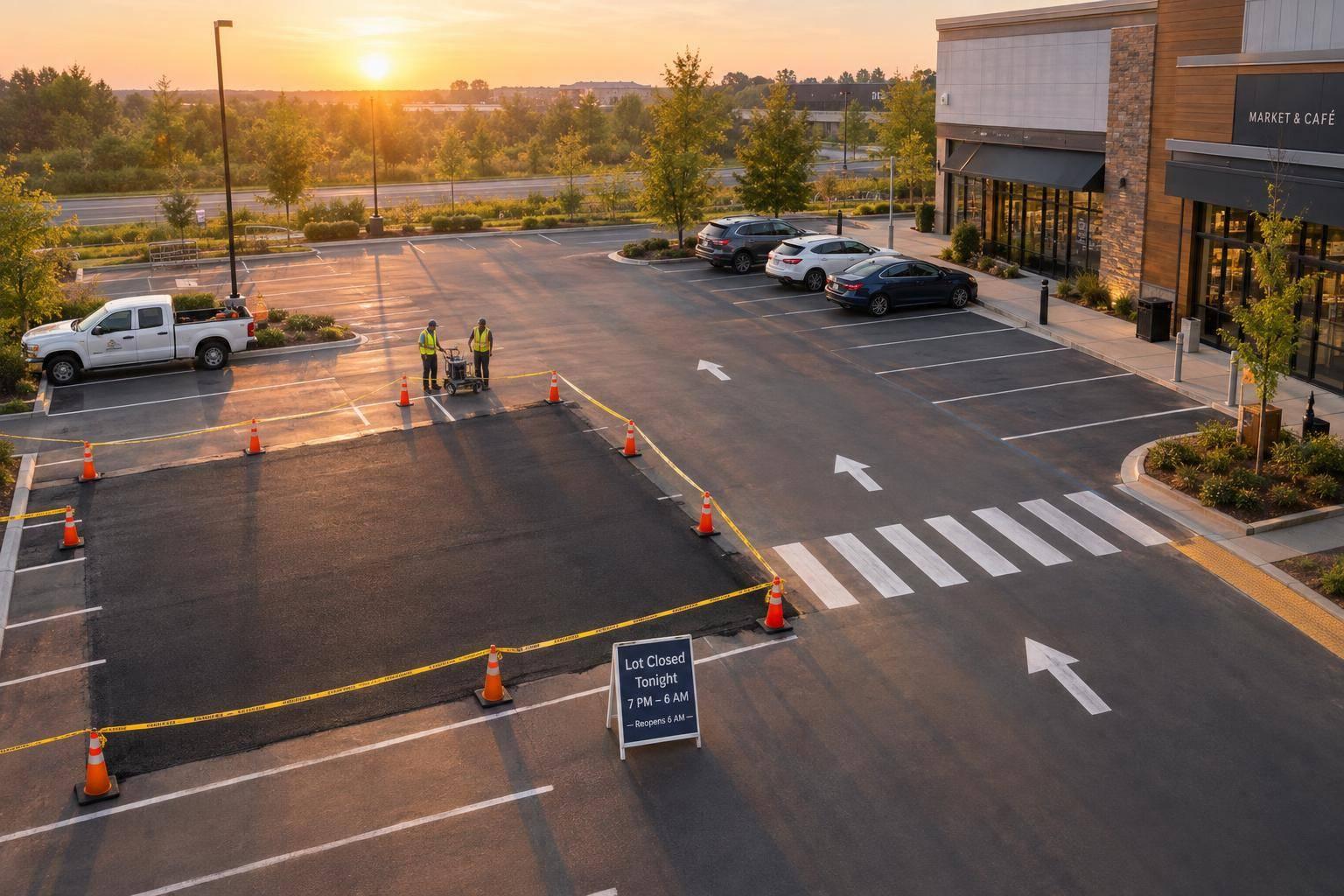
Planning Parking Lot Maintenance Around Business Hours
I plan parking lot maintenance around two things: when your lot is quiet and when it can safely reopen. Before setting a closure, I check actual traffic, deliveries, and staff needs - and ask the contractor to allow for prep, work, and curing.
My planning checklist covers:
- Work schedule: Choose off-hours work or phased closures based on how much parking and access must remain available.
- Safe access: Map temporary parking, delivery and emergency routes, and a clear path from accessible parking to the entrance.
- Closure updates: Share dates, barriers, signs, and alternate routes before work starts and whenever plans change. This is also the ideal time to refresh parking lot striping for maximum visibility.
- Reopening: Confirm material and weather requirements, set a backup date, and keep each zone closed until it is ready for use.
Looking dry does not mean ready for traffic. I review the written plan with the contractor and site staff, including evening or weekend security, and assign one contact for updates. <u>Reopening depends on site conditions and curing - not just the clock.</u>
Choose Off-Hours or Phased Work
Compare Work Schedules
Use the site map to decide whether the job calls for a full closure or work in phases. Match the schedule to the closure needed. Off-hours work may suit sealcoating or major asphalt repairs if the entire lot can close. Phased work may suit striping or small repairs when some parking needs to remain open. This choice sets how much access must stay available during the work.
| Schedule | Potential disruption | Work window | Access limitations | Reopening considerations |
|---|---|---|---|---|
| Off-hours maintenance | Less disruption during business hours, but the lot may need to stay closed until it is ready for traffic | Before opening or after closing | All access points may be temporarily blocked | Reopen only after the contractor confirms the reopening time |
| Phased work | Partial disruption over several work periods | Separate windows for each section | Keeps some access open and maintains a continuous path of travel | Where feasible, reopen each section before moving to the next |
For phased work, count the full area taken out of service, not just the spaces being repaired. In Florida, the accessibility code requires a 12-foot parking stall and a 5-foot access aisle, creating a 17-foot envelope. Include that entire area when calculating how much parking each phase removes from use.
Check the Schedule With Site Staff
Have site staff check the schedule against events, overnight access, and employee parking needs. Confirm whether service vehicles will need access during the planned work window.
Before approving the schedule, ask the contractor to confirm the reopening time for the planned work. If the closure could extend into business hours, get staff agreement on the parking and access arrangements that will be affected.
sbb-itb-bfcbd36
Plan Work Zones and Keep Access Safe
Set Zone Boundaries and Work Order
Once the schedule is set, mark each closure and the next work zone on the closure map. Include temporary parking for customers and employees, delivery routes, and entrance access. Keep these routes outside active work areas. Close zones in sequence so the remaining parking stays reachable.
Have the contractor confirm each phase’s work order in the written plan, including the conditions that must be met before moving to the next zone.
Share Closure Details and Protect Accessible Routes
Once the zone order is fixed, send the closure map to employees, tenants, customers, property managers, and delivery teams before work begins. Use your normal communication channels to share closure dates, hours, and alternate access instructions. Update those instructions whenever a zone changes so people aren’t directed toward a newly closed entrance.
After sharing the plan, use barriers and signs to keep traffic out of active work areas and direct people to the open route. Keep the route from accessible parking to the entrance continuous, unobstructed, stable, firm, and slip-resistant. Before restriping or making pavement changes, review the affected accessible spaces, aisles, routes, markings, and signs with the contractor.
Plan for Weather, Curing, and Reopening
Weather and curing can delay reopening beyond the planned work window.
Check Material and Weather Requirements
Once you set the work window, confirm the cure time and include drying and curing in the closure window. This helps you plan around when customers or tenants need access.
Ask the contractor to confirm the material’s drying and curing requirements for the expected weather and pavement temperatures. Closure time depends on rain, humidity, sunlight, and pavement temperatures - not a fixed schedule.
Confirm when each zone can reopen to pedestrians and vehicles. A surface that looks dry may not be ready for use.
Set Reopening Rules and Allow for Delays
Before work starts, agree on which weather conditions would postpone the job and set a backup work date. Ask the contractor to list the conditions that could delay reopening. Keep each zone closed until it meets the material’s curing requirements.
If a zone won’t reopen before business hours, notify site staff and customers about the revised access plan.
Newly applied sealcoating can still scuff under tight turns after it dries. Ask the contractor whether temporary barriers should stay in place until the surface fully cures.
Conclusion: Review the Written Maintenance Plan
Before work starts, walk the site with the contractor and the property manager or daily operations lead. Check the written plan against peak traffic periods, required access, and the curing time needed before reopening.
Before approving the plan, confirm it covers:
- Zone boundaries, phase timing, and work sequence
- Access for deliveries, emergency vehicles, and accessible parking, plus a continuous, clear pedestrian route
- Traffic controls, weather contingencies, and reopening conditions
Assign one contact to manage schedule updates, and use one channel to communicate revised closures. Keep the plan current until the last area reopens, and make sure it covers site security during weekend or evening work.
FAQs
How much parking should stay open during maintenance?
Plan maintenance in sections to keep part of the lot open and limit disruption to daily access. For striping, use fast-cure paint so each section can typically reopen about 30 minutes after the last pass.
This approach lets you schedule work around business hours and reopen completed sections while American Curb Appeal Inc. repairs or marks other areas.
Can different maintenance tasks share one closure?
Yes. Different maintenance tasks can share one closure when crews work in sections and schedule each step so an area stays closed only as long as needed. Fast-cure striping paint can allow reopening about 30 minutes after the last pass, helping limit downtime around business hours.
If the work changes the driving surface or parking layout, the affected area needs a full ADA striping review after construction.
What if rain starts before the pavement cures?
Rain can affect pavement treatments or markings before they fully cure. Moisture can interfere with sealcoating’s bond and keep striping paint from adhering properly.
Plan maintenance around business hours and use fast-cure materials when possible to reduce exposure risks. If rain is in the forecast, talk with your contractor about adjusting the schedule to protect the work and your investment.
Need parking lot maintenance?
Contact us today for a free proposal on your next pavement project.
Get Your Free Proposal