
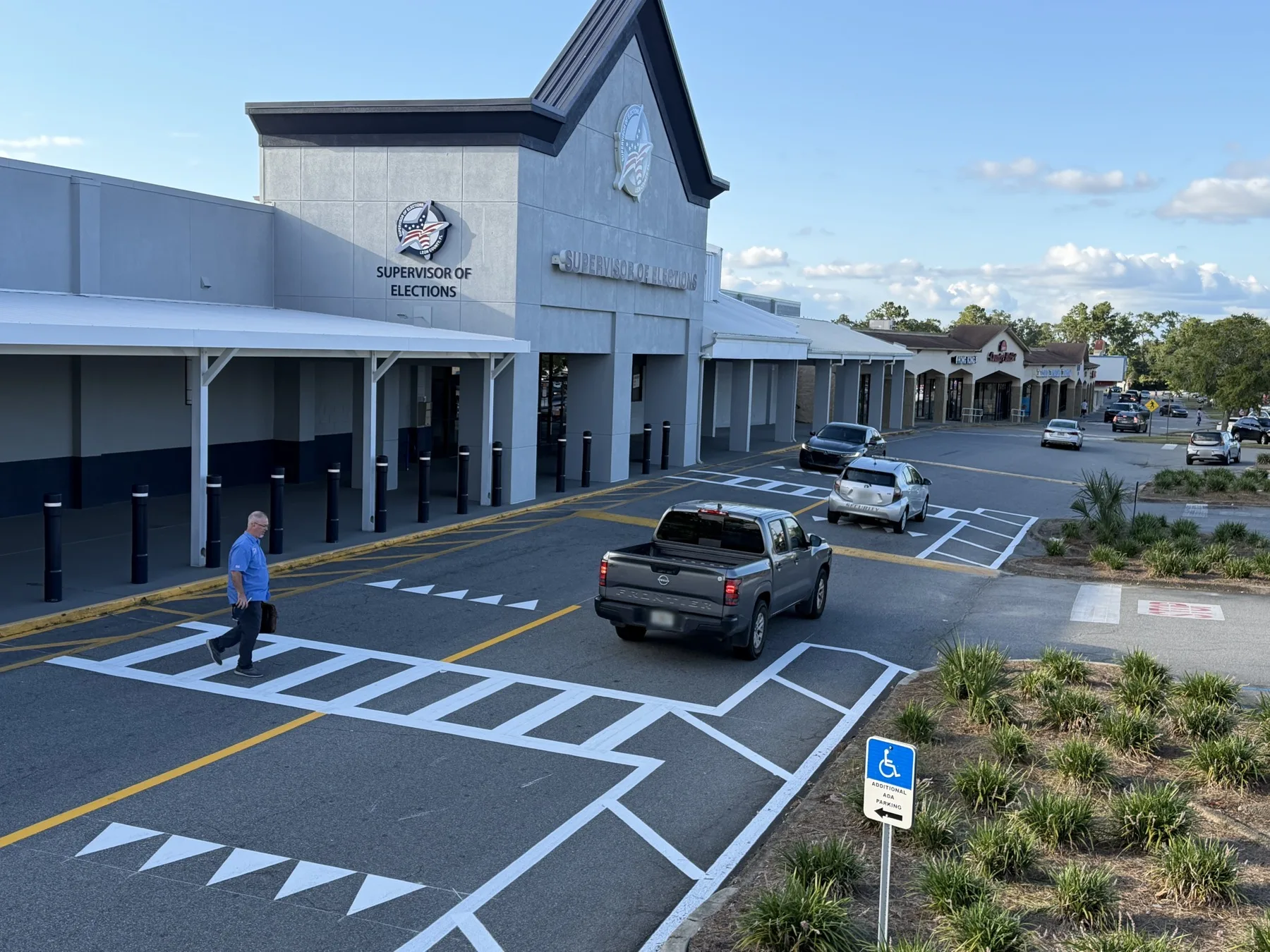
A zebra crosswalk is the high visibility crossing made of wide white bars running parallel to traffic, and shark's teeth are the row of white triangles painted ahead of that crossing, pointing at oncoming drivers to mark where to yield. Together they do one job. They tell a driver that people on foot are expected here. They also tell that driver where to stop looking at parking spaces and start looking at people.
Here's the short version:
- A zebra crosswalk marks the walking route across a drive lane, and the wide bars stay readable longer than thin outlines.
- Shark's teeth sit in the drive lane ahead of the crossing and mark the yield point before the crossing, not on top of it.
- They belong where people leave their cars and walk to a door, which usually means entrances, main drive aisles and the route out of the accessible stalls.
- Faded crossings fail exactly when the lot is busiest.
What a Zebra Crosswalk Actually Communicates
A crosswalk is a conversation between two people who are not looking at each other. The person walking reads it as the protected route. They take it instead of cutting between bumpers where no driver can see them. The driver reads it as a place where a person may step out, so speed drops early.
The zebra pattern is used in parking lots for a practical reason. Two thin parallel lines are read by a driver at a shallow angle, which is the worst angle for seeing them. Wide bars running parallel to traffic present their full width to the approaching driver. The crossing then reads as a solid block of white from the seat of a vehicle. That same pattern holds up better as it wears, because there is more marking on the ground to lose before the message disappears.
Where a lot needs one is usually obvious once you walk it the way a customer does. Park in the far row, get out, and walk to the front door. Wherever that walk crosses a lane vehicles travel through, that is a crossing point whether it is painted or not. People are already crossing there. The marking moves them to the safest place to do it and warns drivers in advance.
What Shark's Teeth Do That a Crosswalk Cannot
Shark's teeth are an advance yield marking. They are painted in the drive lane before the crosswalk, and the triangles point back at the approaching driver. The message is simple. Yield here, not at the crossing itself.
That gap matters more than it sounds. A vehicle stopped on top of a crossing blocks the view for the next driver in the lane. A person already walking stays hidden behind that stopped car until they step out from behind it. Stopping short keeps sightlines open in both directions. Shark's teeth give drivers a place on the pavement to put the front bumper, which is a stronger cue than a sign on a post.
They also work on the pedestrian side. When someone on foot sees that vehicles are expected to stop before the crossing, they walk with more confidence and less hesitation. Hesitation in the middle of a drive lane is where near misses happen.
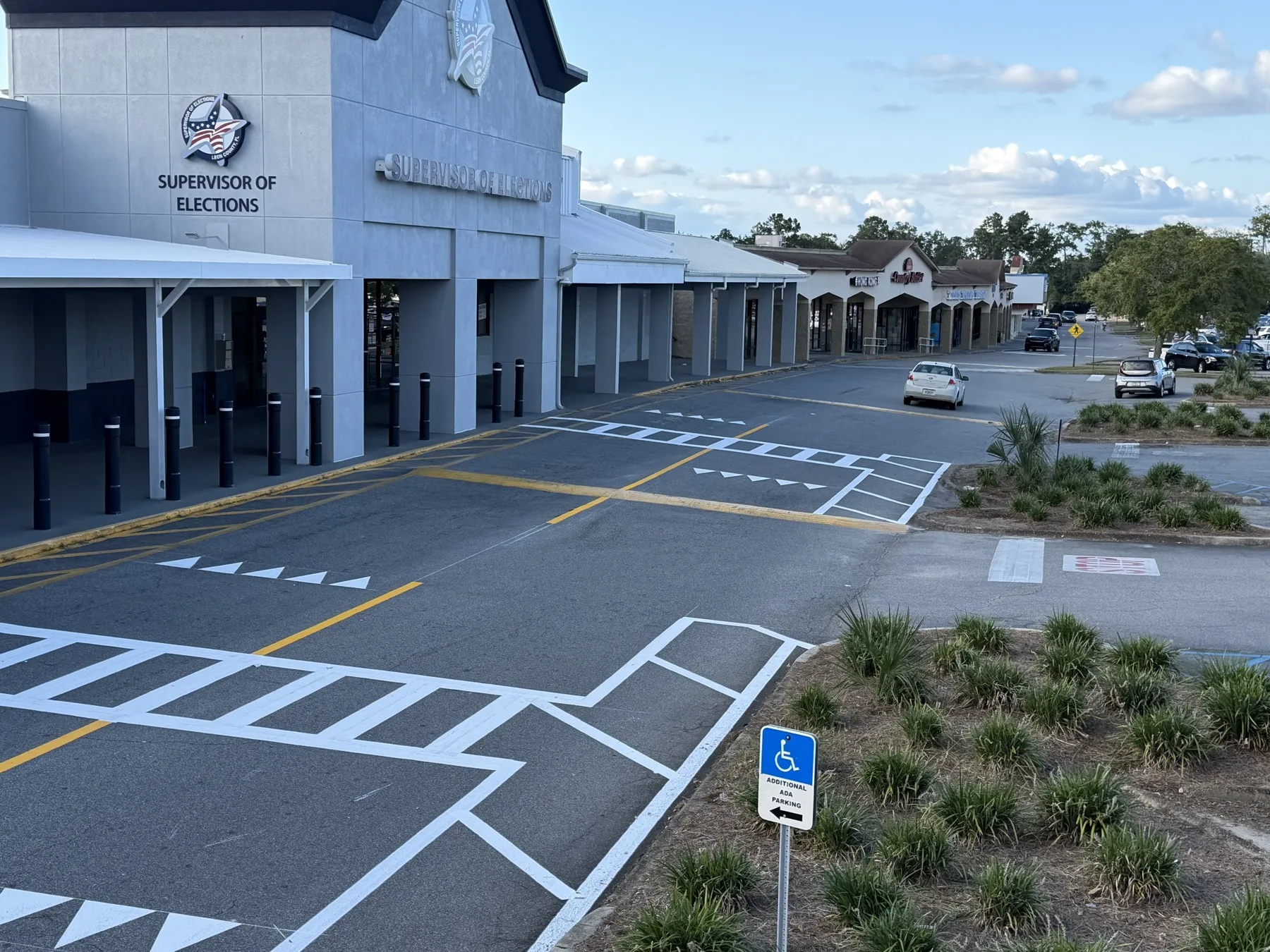
A zebra crosswalk with shark's teeth advance yield markings painted across a commercial drive lane.
Where Each Marking Belongs in a Commercial Lot
| Marking | What it tells the driver | Where we put it |
|---|---|---|
| Zebra crosswalk | People cross here, this is their route | Across drive lanes at entrances, between parking fields and the door, and from accessible stalls to the walkway |
| Shark's teeth | Yield before the crossing, keep sightlines open | In the travel lane on the approach side of a crossing, facing oncoming traffic |
| Hatched access aisle | This is not a parking space | Beside accessible stalls, as part of an ADA layout |
Crossings almost never stand alone. The route has to continue once a person steps off the pavement. That is where the walkway, the ramp and the curb come in. A crosswalk that ends at a broken sidewalk panel or a heaved curb has moved the hazard rather than removed it. On properties where the walking route is part of an accessible path, the crossing, the access aisle and the ramp are all part of the same path of travel. That is work we handle under ADA & Florida Accessibility Compliance and Concrete Construction & Repair.
The layout logic behind all of it is the same logic used when the lot was first designed. Circulation, sightlines and where people naturally walk. We cover more of how marking decisions affect day to day safety in our piece on how parking lot striping improves safety in Lake City.
Why a Faded Crossing Is a Busy Day Problem
Markings do not fail evenly. The parts of a crossing that fade first are the parts tires track over most, which is the center of the lane. That is exactly the part a driver looks at. A crossing can look acceptable from the sidewalk and be nearly invisible through a windshield in afternoon glare.
The other thing to understand is timing. On a quiet Tuesday, a faded crossing costs you nothing. Nobody is crossing and nobody is rushing. The day it matters is the day the lot is full, drivers are circling for a space, and a line of people is walking to the door. That is the same day a worn crossing gives you the least help.
Restriping is also the natural last step after other pavement work. If a lot is due for surface protection, seal first and lay the markings on a fresh surface. That is why we often pair crossing work with High-Performance Sealcoating & Preservation.
A Recent Example in Tallahassee
In September 2026 our crew added zebra crosswalks with shark's teeth advance yield lines at the Leon County Supervisor of Elections at 2990-1 Apalachee Parkway in Tallahassee, ahead of election season pedestrian traffic. That property fits the pattern exactly. Predictable heavy foot traffic on specific days, many drivers unfamiliar with the site, and a walking route from parking that crosses a drive lane. Getting the crossings in before the season meant the markings were working on the days that counted. You can see the work on the Supervisor of Elections crosswalk striping project page.
Get Your Lot Looked At Before Its Next Busy Season
American Curb Appeal has been striping and repairing parking lots in Tallahassee, Crawfordville, Quincy, Havana, Monticello, Perry, Madison, Lake City, Apalachicola and Live Oak since 1998. We do not eyeball lines. We lay out crossings, yield markings and stalls with the same layout methods used on new commercial construction.
If you know your busy season is coming, that is the time to call. We will come walk the lot with you and look at where people are actually crossing. For commercial properties we put the scope in writing so you can see what is being striped, what is being brought up to ADA code and what is optional. Start with our parking lot striping and precision layout service or call us at (850) 545-1776.
FAQs
Do shark's teeth have to be used with every crosswalk?
No. They are most useful where drivers approach a crossing with speed or with limited sightlines, such as a main drive aisle. On a short, slow crossing in a quiet corner of a lot, a well marked crossing may be enough on its own. We look at how traffic actually moves through your site first.
How do I know when my crossings need to be repainted?
Look at them from a vehicle, not from the sidewalk. Pull in the way a first time visitor would, at the time of day your lot gets the most glare. See whether the crossing reads as a clear block of white. If the center of the lane has worn thin or gone gray, it is past due.
Can crossings be added to a lot that was built without them?
Yes. In most cases this is a layout question more than a construction question. We map where people already walk between the parking field and the entrances, place the crossing on that route, and add advance yield markings on the approach. If the route runs into a damaged walkway or curb, we address that too.
Should I seal the lot first or stripe first?
Seal first. Sealcoating is a surface coating, so any markings under it get covered. Laying crossings and stalls onto freshly protected pavement gives the markings a clean, uniform surface. It also keeps you from paying for the same paint twice.
How do we get a bid for crossing and striping work?
Call or send the request through our site and we will come walk the lot. For commercial properties we put the numbers in writing with the scope broken out. You can see what is being striped, what is being brought up to ADA code and what is optional.
Need parking lot maintenance?
Contact us today for a free proposal on your next pavement project.
Get Your Free Proposal