
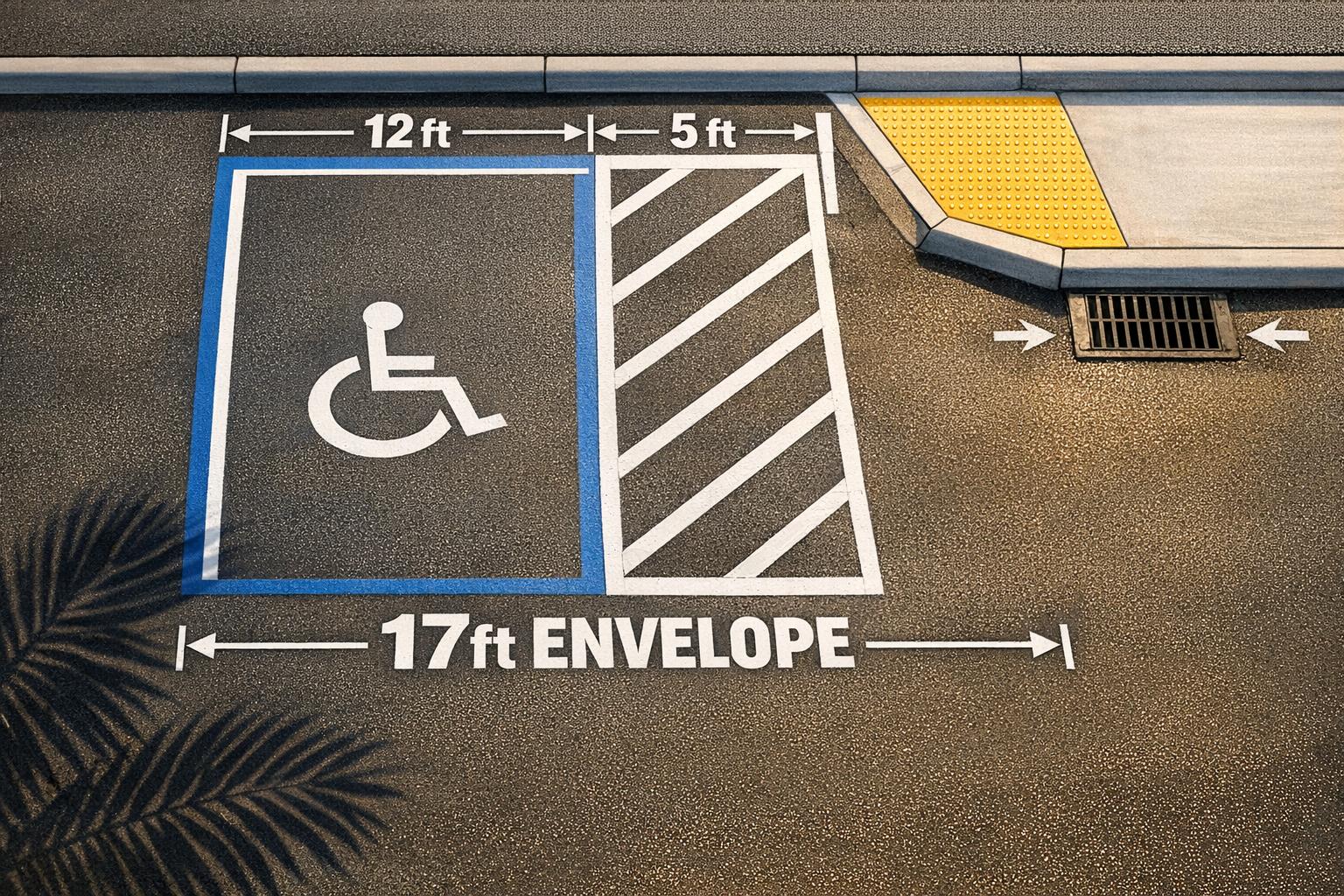
The 17-Foot Envelope: Why Florida’s "Wide Stall" Layout is a Specialist’s Game
Florida’s "17-foot envelope" parking layout goes beyond federal ADA requirements to prioritize accessibility and safety. This design pairs a 12-foot parking stall with a 5-foot access aisle, creating a total width of 17 feet. It ensures space for mobility aids, safer navigation, and compliance with Florida’s stricter accessibility standards.
Key points:
- Accessibility Focus: Wider spaces and marked access aisles prevent mobility aid users from navigating behind vehicles.
- Strict Standards: Florida requires slopes no steeper than 1:48 and vertical clearance of 98 inches for van-accessible routes.
- Dual Compliance: Both ADA and Florida Building Code rules apply, with the stricter standard taking precedence.
- Design Challenges: Wide stalls demand careful attention to drainage, traffic flow, and durability to handle Florida’s heavy rainfall and high temperatures.
- Maintenance Needs: Regular upkeep like crack sealing, sealcoating, and restriping is critical to maintaining compliance and usability.
Florida’s approach highlights the importance of precise design, thorough maintenance, and expert knowledge to meet accessibility and safety requirements effectively.
Florida Building Code and ADA Requirements for Wide Stalls
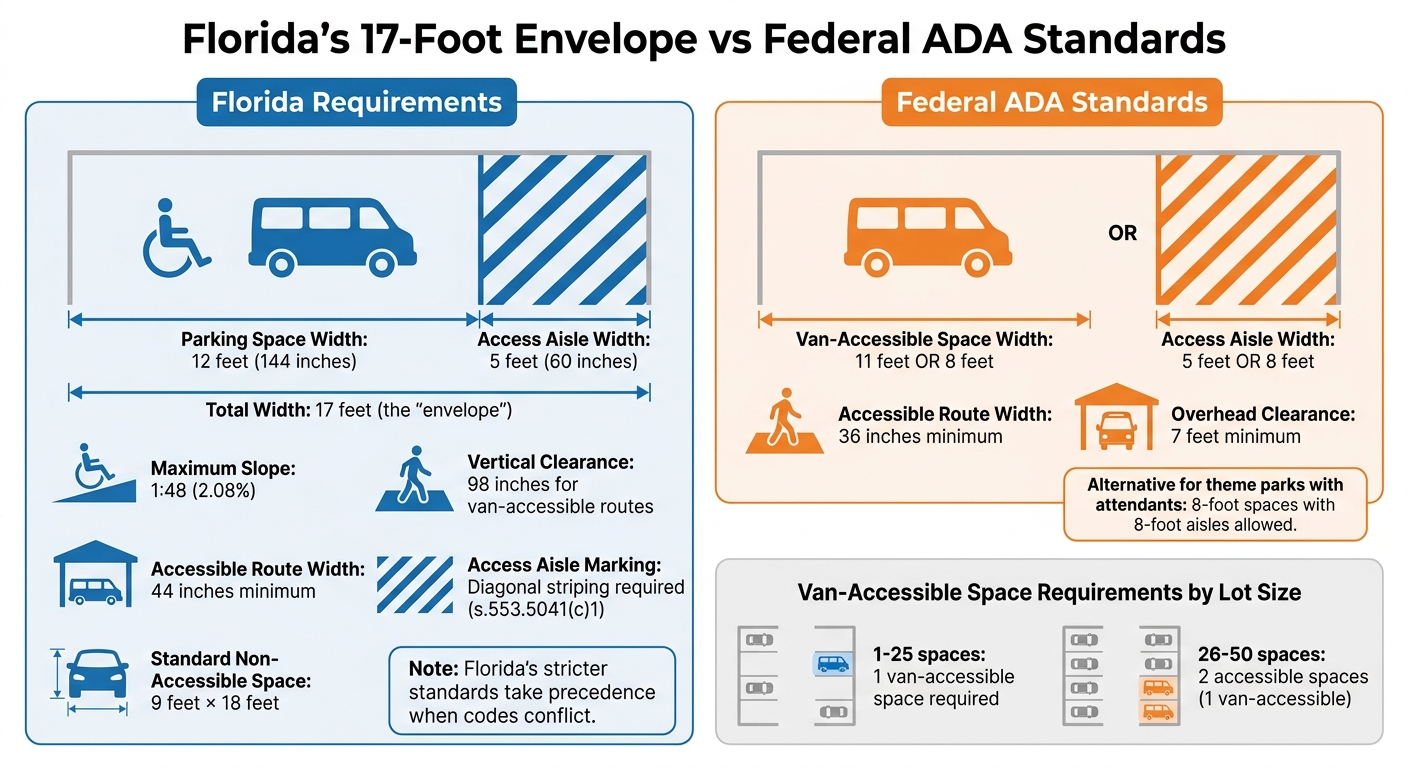
Florida 17-Foot Envelope vs Standard ADA Parking Requirements Comparison
Florida parking regulations require adherence to both the federal ADA Title III and Florida Building Code (FBC) Chapter 11. When these two codes conflict, the stricter rule must be followed to ensure compliance and avoid potential legal issues or federal enforcement actions. For property managers and contractors, this means prioritizing the more restrictive provision to meet legal obligations.
Failing to comply can result in fines and delays in obtaining a Certificate of Occupancy, which can push back project timelines and tenant move-ins. Additionally, federal regulations mandate that for renovations impacting primary function areas, up to 20% of the total construction cost must be allocated to making the path of travel accessible. This includes parking areas and routes. These dual compliance requirements add layers of complexity to design and construction processes.
Required Dimensions and Specifications
Florida's accessible parking spaces must be at least 12 feet wide (144 inches), significantly wider than the federal ADA standard of 8 feet. When paired with a 5-foot (60-inch) access aisle, the total width reaches 17 feet, defining Florida's standard for wide stalls. In contrast, standard non-accessible parking spaces in Florida are typically 9 feet wide by 18 feet long.
Access aisles must run the full length of the parking space and include diagonal striping, as required by Florida law (s.553.5041(c)1). Additionally, accessible routes connecting parking spaces to building entrances must be at least 44 inches wide, exceeding the federal minimum of 36 inches. This ensures that individuals using wheelchairs or mobility aids can navigate safely without having to move behind other parked vehicles. These measurements are designed to optimize both traffic flow and safety in Florida's parking configurations.
For theme parks and entertainment venues with continuous attendant services, an alternative layout of 8-foot wide spaces with 8-foot access aisles is allowed. On-street parallel parking must also accommodate accessibility by ensuring curbs are low enough to allow vehicle doors to open freely.
ADA Requirements for Accessible Parking
The ADA adds further specifications for accessible parking, including requirements for van-accessible spaces based on the total number of parking spaces in a lot. For lots with 1 to 25 spaces, at least one van-accessible space is required. For lots with 26 to 50 spaces, two accessible spaces are needed, with at least one being van-accessible. Under ADA guidelines, van-accessible spaces must either be 11 feet wide with a 5-foot aisle or 8 feet wide with an 8-foot aisle. For angled parking, the access aisle must be positioned on the passenger side of the van.
All off-street parking areas must maintain a minimum overhead clearance of 7 feet, and regulatory signage must have a minimum bottom clearance of 7 feet above the pavement. Non-compliance can lead to enforcement actions by the Department of Justice, private lawsuits under 42 U.S.C. § 12188, and complaints filed with Florida's Department of Business and Professional Regulation. For property managers and contractors, understanding and implementing these ADA requirements is critical to avoiding legal and financial risks while maintaining accessible and compliant parking layouts.
sbb-itb-bfcbd36
Design and Engineering Challenges for 17-Foot Layouts
In Florida, designing 17-foot wide stall layouts presents a unique set of challenges due to the state's stringent ADA and building code requirements. These layouts must accommodate not only passenger vehicles but also heavier vehicles like garbage trucks and fire apparatus, which demand extra maneuvering space and durable pavement surfaces. However, the wider design isn't just about increasing dimensions - it introduces new complexities such as load distribution and managing a larger impervious surface area. This expanded surface can heighten risks of flooding and pollution caused by stormwater runoff.
Another issue is the urban heat island effect caused by extensive paving. As Daniel Herriges, Policy Director of the Parking Reform Network, explains:
All that parking is pavement that absorbs heat from the sun and contributes to the deadly urban heat island effect
. This heat buildup accelerates pavement wear, reducing its lifespan and increasing the need for ongoing maintenance.
Pavement Strength and Load Requirements
To handle the demands of wide stall layouts, engineers typically use asphalt or concrete surfaces designed to withstand heavy loads and manage surface water runoff. These surfaces must be particularly strong in areas where wide stalls intersect with truck loading zones or emergency vehicle access routes. For example, emergency access lanes in large developments must meet specific standards, such as a minimum width of 25 feet and corner radii of 25 feet inside and 45 feet outside, to ensure proper maneuverability.
Florida's high temperatures add another layer of complexity, as they accelerate asphalt wear and lead to issues like wheelpath rutting. These depressions can disrupt drainage, allowing water to pool and increasing the risk of accidents. To address this, property managers are encouraged to monitor for rutting and take corrective actions like resurfacing or diamond grinding to maintain proper drainage and safety.
Drainage and Slope Requirements
Florida's heavy rainfall makes effective drainage design critical. Surfaces must have a proper drainage gradient to prevent water pooling and reduce hydroplaning risks. For accessible wide stalls, the slope must remain nearly level, with a maximum allowable slope of 1:48 (about 2.08%) to ensure compliance with accessibility standards. At the same time, a minimum drainage gradient of 0.5% is generally recommended to reduce skidding hazards.
Designs must also adhere to South Florida Water Management District rules, which address the increased stormwater runoff from larger paved areas. Accessible 17-foot layouts should be placed in areas that avoid standing water to enhance safety and extend the pavement's lifespan. While pervious or partially pervious surfaces can help meet water quality requirements, their use requires approval from the City Engineer. These factors significantly influence both the durability of the pavement and the maintenance strategies needed to keep these layouts functional over time.
Traffic Flow Optimization in Wide Stall Layouts
Optimizing traffic flow is essential for improving both safety and efficiency in parking lots, alongside meeting ADA and structural requirements. Wide stall layouts help reduce congestion by minimizing the amount of maneuvering needed when vehicles enter or exit parking spaces. The 17-foot envelope addresses narrow aisle challenges, allowing smoother vehicle movement. This is particularly relevant in Florida, where larger vehicles like pickup trucks and SUVs are common and require more space to turn compared to standard passenger cars.
To ensure adequate turning space, use a 22-foot design vehicle template. Turning radius needs vary by vehicle type: standard passenger cars generally need 25–30 feet, pickup trucks and SUVs require 30–35 feet, and full-size vans may need 35–40 feet. These measurements provide a baseline for aligning turning requirements with the overall layout of the lot.
One-Way Aisles and Turning Radii
Strategic aisle design plays a significant role in improving lot safety and traffic efficiency. One-way aisles, often used in specialized layouts, help avoid head-on conflicts and make navigation easier for drivers. For 90-degree parking, the minimum width for a one-way aisle is 18 feet, while two-way aisles should be at least 24 feet wide.
Before applying pavement markings, sketch a circulation loop to outline drive aisles and restricted areas. Align main drive aisles with the primary driveway to prevent sharp turns immediately after entry. Reinforce one-way flow by placing directional arrows directly within the aisles, not just at intersections. This consistent visual guidance helps drivers quickly understand the layout.
Entry, Exit, and Safety Features
Parking lots should be designed to allow vehicles to exit spaces and enter adjacent streets in a forward direction without requiring complex maneuvers. The layout should also enable internal movement throughout the lot without relying on public streets to connect different aisles. Incorporate buffers in drive aisle and stall designs to prevent interference during vehicle movements.
Use clear markings such as "DO NOT ENTER" signs, directional arrows, stop bars at aisle ends, and crosswalks to define pedestrian pathways and separate entry and exit flows. Ensure that landscaping and light poles do not block sight lines at entry and exit points. Critical decision points like turns, stops, and crossings should be well-lit to keep pavement markings visible at night.
Fire lanes must remain at least 20 feet wide, or 24 feet for larger buildings, to ensure emergency vehicles have proper access. All traffic control devices, including signs and pavement markings on private property, must comply with the Manual on Uniform Traffic Control Devices (MUTCD) standards. These integrated traffic management features highlight the importance of Florida's 17-foot envelope, complementing the structural and maintenance considerations discussed earlier.
Maintenance Methods for Extending Pavement Life
When managing the rigorous demands of 17-foot envelope layouts, staying on top of maintenance is essential. Regular resealing, which costs about $0.19 per square foot, can help avoid the much higher expense of resurfacing, which runs around $1.60 per square foot. As The Diamond Solutions puts it:
If an ounce of prevention is worth a pound of cure, then parking lot maintenance services (also called pavement maintenance) are the cheaper and easier prevention to paving's expensive and time-consuming cure
.
The key to extending pavement life lies in four main practices: crack sealing, sealcoating, line striping, and asphalt patching. In Florida, where heavy rainfall is common, crack sealing plays a critical role in keeping moisture out of the gravel subgrade, which helps prevent foundation erosion. For cracks larger than 1/8 inch, hot rubberized sealant is the most effective option, as it expands and contracts with temperature changes.
Sealcoating and Crack Filling
Sealcoating creates a protective layer that shields the pavement from water damage and wear. To maintain its effectiveness, reapply sealcoating every 2–3 years, and perform annual inspections to catch and repair cracks before they turn into potholes.
For high-traffic areas, infrared patching offers a more reliable solution compared to traditional cold patching. This method seamlessly integrates new asphalt with the existing surface, ensuring longer-lasting repairs. Address potholes promptly using commercial-grade materials to safeguard the subgrade and prevent further damage.
These preventative measures not only protect the pavement but also provide a solid foundation for clear striping and timely surface repairs, which are especially important for the unique challenges of 17-foot envelope layouts.
Striping and Surface Repairs
To combat wear and fading caused by traffic and weather, parking lot striping should be refreshed every 12–24 months. Always restripe immediately after sealcoating or resurfacing. Using water-based latex paint ensures a quick turnaround, as it dries in just 30 minutes, allowing traffic to resume with minimal disruption.
For areas with heavy traffic or fire lanes, thermoplastic markings are a durable option, lasting 3–5 years. While these markings cost two to three times more per linear foot, their longevity makes them a worthwhile investment. To minimize inconvenience, schedule work during nights or weekends, and consider phasing the project in sections to maintain partial access to the lot throughout.
Case Studies: 17-Foot Envelope Implementations in Florida
Orlando Kia Center Lot

The redesign of the Orlando Kia Center parking lot showcases how the 17-foot envelope can address both stormwater challenges and traffic flow concerns. Previously, the lot's impervious surfaces caused frequent flooding and runoff pollution issues.
The retrofit introduced perpendicular (90-degree) stall arrangements, which are ideal for two-way traffic flow. This setup allows vehicles to exit parking spaces without requiring complex maneuvers. By keeping users from navigating behind parked cars, this layout also reduces the risk of accidents in busy areas. Additionally, the inclusion of a 5-foot access aisle ensures enough space for deploying vehicle lifts and ramps, a critical feature for properties serving patrons with disabilities.
Commercial properties in North Florida have also adopted similar designs to enhance both capacity and accessibility.
North Florida Commercial Sites
North Florida commercial sites have refined the wide stall approach by aligning aisles parallel to the longer side of their lots. Architect Joann Lui, AIA, explains:
"The ideal parking lot should be rectangular with aisles and rows located parallel to the long side of the site - this increases lot capacity by 20%."
Automated ADA tables are used to calculate the number of accessible car and van spaces required based on the total lot capacity. Real-time AI tools further optimize turning radii and aisle placement, making navigation easier. To extend the lifespan of these busy lots, property managers follow regular maintenance routines, including sealcoating and crack filling.
For compliance, the 5-foot access aisle is clearly marked with diagonal striping and designated as a no-parking zone. Permanent above-grade signs are installed at a height of 84 inches from the ground to the bottom of the sign, ensuring visibility and adherence to regulations.
Conclusion
Florida's 17-foot envelope sets a strict legal benchmark that demands precise design and execution. The state requires parking spaces to be 12 feet wide, accompanied by a 5-foot access aisle, with slopes not exceeding 2%. Even seemingly small issues - like worn-out striping or blocked pathways that force wheelchair users into unsafe areas - can result in non-compliance.
"ADA compliance is not a suggestion; it is a rigid legal requirement. In Florida, parking lot accessibility is a primary target for litigation." – American Curb Appeal
Routine maintenance plays a key role in staying compliant. Practices like sealcoating, crack filling, and restriping with high-contrast paint not only extend the life of the pavement but also ensure that access aisles remain clearly marked as no-parking zones. Regular audits against the Florida Accessibility Code help property managers catch problems like incorrect stall dimensions, improper slopes, or missing signage before they lead to legal trouble. These proactive steps create a solid foundation for compliance, but expert partnerships are often essential for addressing more complex requirements.
By working with specialists who understand Florida's specific regulations - such as proper installation of R7-8 signage, tactile warning surfaces at curb ramps, and maintaining the 98-inch vertical clearance for van-accessible routes - property managers can minimize risks and ensure long-term compliance. With more than 28 years of experience in pavement preservation and Florida accessibility standards, American Curb Appeal offers a detailed four-step process: compliance audits, identifying deficiencies, precise execution, and final verification.
Achieving compliance with wide stall layouts requires more than just technical knowledge - it demands attention to detail, a commitment to accessibility, and an understanding of the serious consequences of non-compliance. Expert handling ensures these high standards are met, protecting both property owners and the communities they serve.
FAQs
When do I have to follow Florida rules instead of ADA?
When your project is subject to Florida-specific accessibility requirements, you must adhere to Florida's rules rather than the ADA. This means following the Florida Accessibility Code and the Florida Building Code, which include regulations tailored specifically to the state.
Can I fit 17-foot accessible stalls without losing too many spaces?
Yes, 17-foot accessible stalls can fit without drastically cutting down the number of parking spaces. Many regulations permit a minimum width of 9 feet and a length of 18 feet for standard spaces, and up to 20% of spaces can often be slightly reduced in size. However, careful planning is crucial to ensure compliance with ADA standards while maintaining overall parking efficiency.
How do I keep wide stalls compliant after striping fades and pavement settles?
Regular upkeep plays a crucial role in ensuring wide stalls remain compliant. It's important to inspect the parking lot regularly and re-stripe as needed to keep the dimensions in line with ADA standards. If the pavement has settled and caused misalignment, repairs or leveling might be required before re-striping can be done. Staying on top of maintenance helps ensure stalls are accessible, properly aligned, and meet legal size requirements, reducing the risk of compliance issues or liabilities.
Need parking lot maintenance?
Contact us today for a free proposal on your next pavement project.
Get Your Free Proposal