
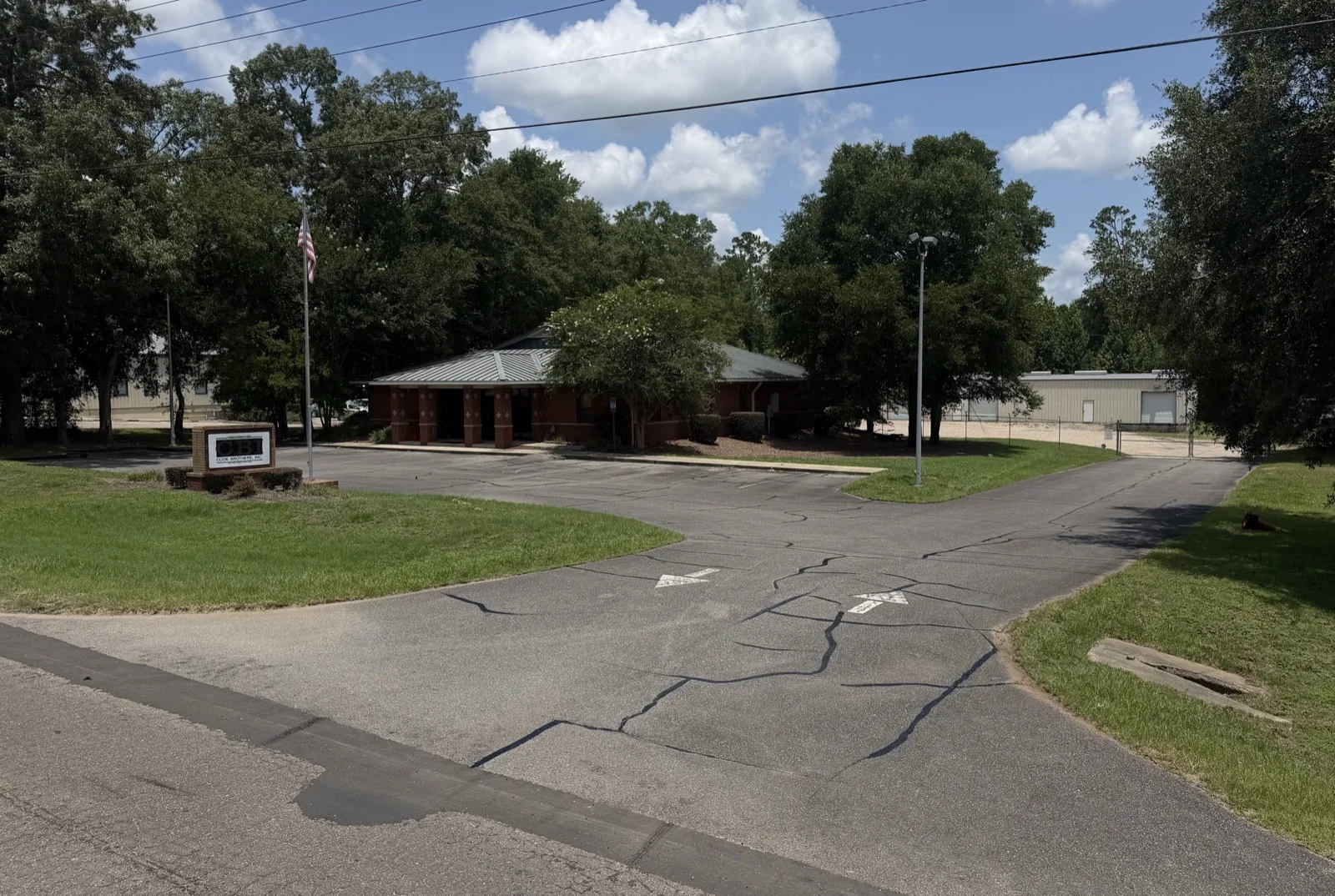
Most accessible parking problems we find at retail centers come down to four things: stall and aisle width, surface slope, signage a driver can see, and the route from the stall to the door. Those four items are checkable in a single walk of your lot with a tape measure and a phone camera. We have been doing this work in North Florida since 1998, and the same handful of details account for most of what goes wrong. Here is how to verify yours before the year closes out.
Here's the short version:
- In Florida, the accessible stall is laid out 12 feet wide with a 5 foot wide hatched access aisle, which makes every space van accessible from the start.
- Slope matters as much as paint. A slope over 2 percent in any direction turns a legal looking stall into a non compliant one.
- Signage and the accessible route to your storefront doors are part of the same system, and a photo record of all of it protects you.
Start With the Stall and the Aisle Beside It
Walk out to your accessible spaces and measure. The Florida layout we execute is a 12 foot wide parking space paired with a 5 foot wide hatched access aisle. That combination is what makes the space usable by a van with a side mounted lift, and it is why we lay out every accessible stall to be van accessible rather than guessing which one a customer will need.
The common failure at older retail centers is drift. A lot gets restriped by whoever was cheapest, the painter follows the ghost lines of the previous layout instead of measuring, and over two or three cycles the stall loses several inches and the access aisle narrows. Nobody notices because the lot looks freshly striped. The dimensions are what count, not the shine.
The hatching itself is also a detail people skip. Florida requires specific pavement markings in the access aisle telling drivers not to park there, in addition to the hatched stripes. An access aisle with faded hatching invites someone to squeeze a car into it, which blocks the lift and defeats the whole arrangement. We cover the reasoning behind these wider Florida stalls in more depth in our breakdown of why Florida's wide stall layout is a specialist's game, and it is worth reading before you approve any restripe bid.
If your lines are faded to the point that you cannot tell where the original layout intended the stalls to sit, that is a layout problem rather than a paint problem, and it belongs with Parking Lot Striping & Precision Layout work rather than a quick touch up.
What the Slope Does to an Otherwise Perfect Stall
This is the detail that surprises retail owners most. A slope exceeding 2 percent in any direction turns a parking space into a non compliant one, no matter how perfectly it is striped and signed. The stall and the access aisle both have to stay inside that limit. A wheelchair should not roll away from its user, and a lift should not deploy onto a tilted surface.
Older Live Oak lots often have accessible stalls placed near a building where the pavement was built to shed water toward a drain or a swale. The grade that keeps water off your sidewalk can also push the stall past the limit. Settlement makes it worse over time. A low area that holds water after a storm is a visible clue that the surface has moved since it was built.
Checking this takes a level or a slope app and a few minutes per stall. If a stall is out of tolerance, the fix is not paint. It is leveling and slope correction, which means addressing the pavement surface itself through Asphalt Restoration & Structural Repair so the finished grade sits where it needs to be before new striping goes down.
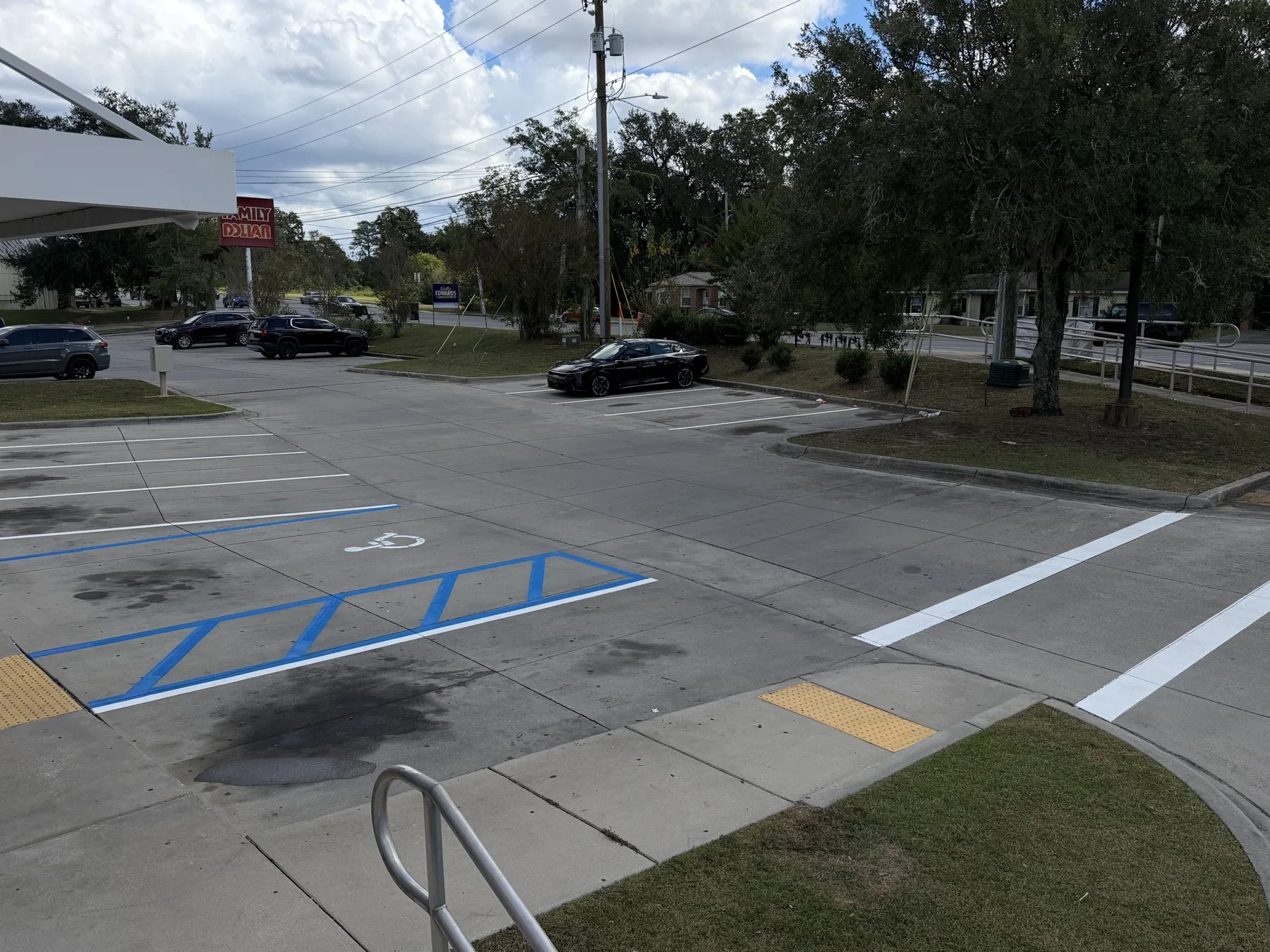
A striped accessible stall with its hatched access aisle, the pairing a year end walk should confirm first.
Signage a Driver Can Actually See
Florida has signage requirements that go beyond the federal baseline, including specific blue and white signage at accessible spaces. Two things go wrong with it at retail centers.
The first is per stall coverage. Each accessible space needs its own sign. One sign serving a pair of stalls is a gap, and it is an easy one to spot from your own parking lot.
The second is mounting. A sign has to be high enough that a driver pulling in can read it over the hood or roof of a vehicle already parked. Signs that sit low behind a curb stop get hidden the moment a pickup parks next to them, and a sign nobody can see does not do its job. Bent posts, faded faces, and signs knocked loose by a delivery truck all belong on the year end list. Our ADA Compliance & Signage Guide walks through the signage side in more detail.
The Route From the Stall to the Door
The Path of Travel is the continuous, unobstructed route that connects the accessible parking space to the building entrance. It has to be stable, firm, and slip resistant, with no trip hazards and no excessive slopes. For a retail center, that means the ramp or curb cut, the sidewalk along the storefronts, and the landing at the door are all part of your accessible parking, even though none of them are pavement markings.
Walk it the way a customer would. Look for heaved or cracked sidewalk panels, a lip where a ramp meets the asphalt, a broken curb, or a planter and a sandwich board narrowing the walk. Heaved and cracked panels are a liability item on their own, and we handle them through Concrete Construction & Repair, including sidewalk restoration, trip hazard removal, curb reconstruction, and ADA ramps.
A simple year end checklist
| Detail | What to verify | Common failure |
|---|---|---|
| Stall width | 12 feet wide | Narrowed over repeated restripes |
| Access aisle | 5 feet wide, hatched | Faded hatching, no "no parking" marking |
| Slope | Within 2 percent, stall and aisle | Settlement, drainage grade at the building |
| Signage | One per stall, blue and white | Visible only when the adjacent stall is empty |
| Path of travel | Firm, level, unobstructed | Heaved panels, ramp lip, clutter |
What to photograph
Build your own record while you walk. Photograph each accessible stall with the tape measure in frame across the stall and across the access aisle. Photograph the sign from a driver's seat height so the image shows what a customer sees. Photograph the hatching, the ramp, the sidewalk panels along the route, and the entrance landing. Date the folder. If a complaint ever lands, a dated photo set showing the condition of your lot is worth far more than a memory of when it was last striped.
Verifying Your Live Oak Lot With American Curb Appeal
Live Oak is one of the communities we serve out of Tallahassee, and accessibility work has been part of what we do for 28 years. On the pavement side we handle stall geometry, hatched access aisles, wheelchair symbols, and slope correction. On the approach side we handle the concrete that carries people to your doors. When we bid a commercial property, we put the numbers in writing with the scope broken out so you can see what is being striped, what is being brought up to ADA code, and what is optional, rather than one lump figure.
"American Curb Appeal does an incredible job at a very fair and competitive price. Terry is a great communicator, and his attention to detail is exceptional. Highly recommend this company for any asphalt needs." Noah C., Tallahassee
If you want a second set of eyes on your lot before year end, call us at (850) 545-1776 or request a walk through our ADA and Florida accessibility compliance service. We will walk the lot with you and show you what we see.
FAQs
What are the Florida specific requirements for ADA parking?
Florida has unique requirements that go beyond federal standards, including specific blue and white signage and "no parking" pavement markings in access aisles. We lay out the 12 foot wide space with the 5 foot wide hatched access aisle. We make sure your lot meets the Florida Accessibility Code for Building Construction.
Can a stall be fixed with paint if the slope is too steep?
No. Paint does not change grade. If the stall or the access aisle slopes more than 2 percent in any direction, the surface itself has to be corrected before striping goes back down. That is leveling and slope correction work, and it should happen first so the new layout lands on pavement that holds up.
Does the sidewalk in front of my stores count as part of ADA parking?
It does, as part of the Path of Travel. That route from the accessible space to the building entrance has to be stable, firm, and slip resistant with no trip hazards or excessive slopes. Heaved or cracked sidewalk panels and broken ramps are part of the same compliance picture as the striping.
How do we get a bid for our Live Oak retail center?
Call or send the request through our site and we will come walk the lot. For commercial properties we put the numbers in writing with the scope broken out, so you can see what is being striped, what is being brought up to ADA code and what is optional. That way you can prioritize rather than approve or decline one lump sum.
Need parking lot maintenance?
Contact us today for a free proposal on your next pavement project.
Get Your Free Proposal