
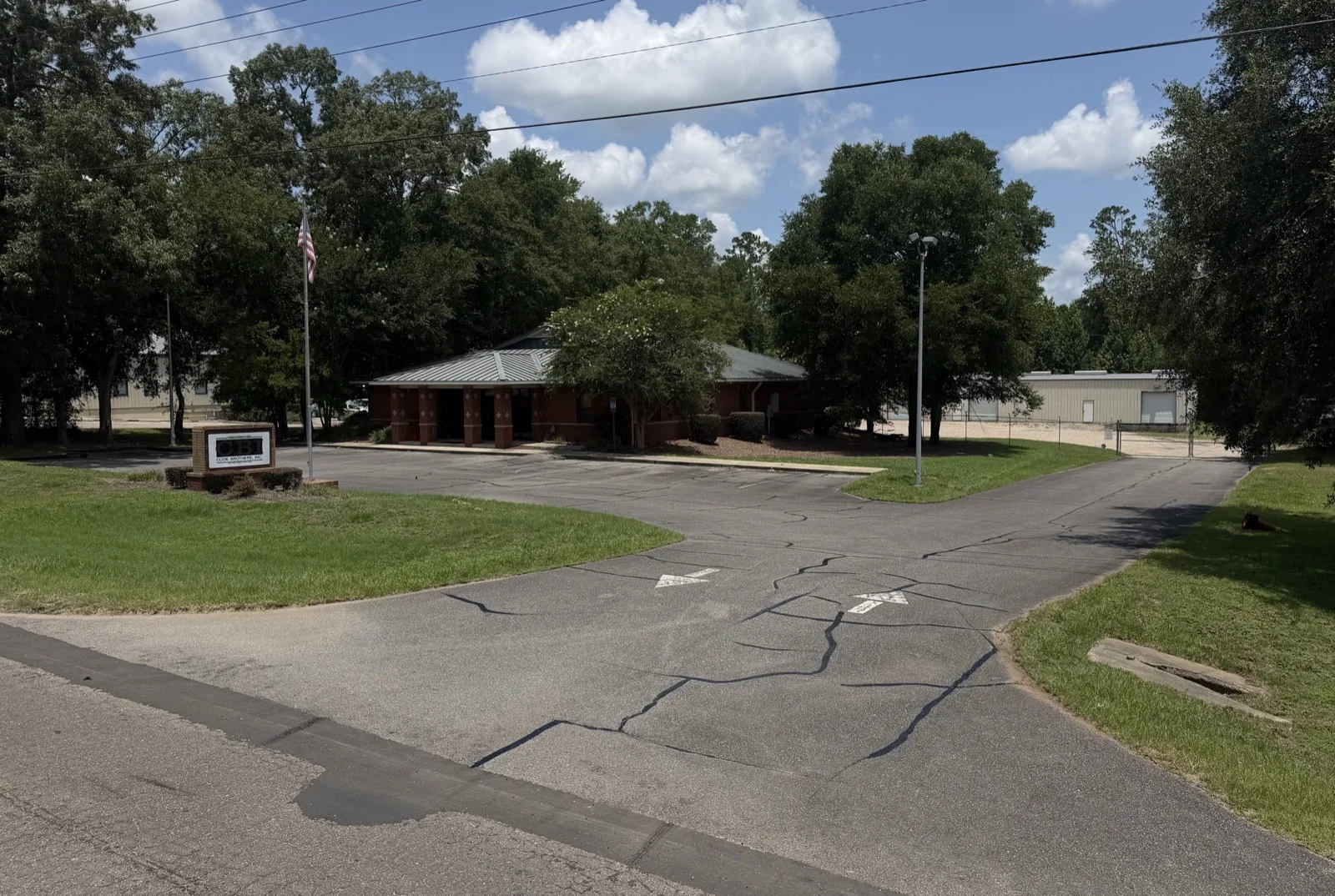
A drive-thru that backs up into the street is usually a layout problem wearing a staffing costume, and the fix starts with paint. When the lines that tell a driver where to stack are worn off, every car makes its own decision. We have been striping and laying out commercial lots in the Tallahassee region for 28 years, and the busy weeks are when weak markings show up as a line in the road.
Here's the short version:
- Faded or missing stack lane markings let cars queue in the wrong place, which is what pushes the tail of the line out of your lot.
- Order point, window, merge and crossing markings each do a specific job, and all of them have to agree with each other.
- Directional arrows and a bypass or escape lane keep the parking side of the lot from locking up behind the queue.
- Striping work gets staged overnight or in sections so the restaurant stays open.
Why the Line Ends Up in the Street
A drive-thru queue is a storage problem. Your lot holds a certain number of cars between the entrance and the window, and the job of the striping is to make drivers use all of that storage in the right order. When the paint is gone, drivers stop trusting the lane and start improvising. They stack two abreast near the menu board, they stop short of the curve because they cannot tell whether the lane continues, and they leave gaps that would have held another two or three vehicles. The tail end of that queue has to go somewhere, and it goes toward the entrance and then past it.
The second thing that pushes the line out is conflict. If a driver cannot tell whether the lane they are in is for the drive-thru or for the parking rows, they hesitate. Hesitation at the mouth of the lot is what turns a long line into a stopped line. Clear lane edges, clear arrows and a clear decision point at the entrance remove the hesitation before a car ever commits.
In our experience the restaurants that handle holiday volume well are not the ones with the biggest lots. They are the ones where the markings make the correct path obvious at five miles an hour with a windshield full of glare.
How We Lay Out the Stack Lane
We do not eyeball lines. We use the same mathematical layout techniques required for new commercial developments, which means the stack lane gets measured, snapped and checked against the rest of the lot before any paint goes down. On a drive-thru that usually means a defined lane width that a pickup or a delivery van can hold without clipping a curb, a lane edge that stays consistent through the curve rather than pinching in, and a stripe pattern that reads as one continuous path from the entrance to the window.
Because we have done layout for new construction as well as maintenance restriping, we also look at the civil engineer's reason behind the original lanes. Sometimes the existing layout was drawn for a floor plan that no longer exists, a second order point was added, or a dumpster enclosure got moved. Strategic re-mapping is often where the real capacity gain is. Shifting a lane edge or re-cutting the entry taper can add stacking depth without touching a single square foot of asphalt. If you want the full picture of how a layout gets built from scratch, our breakdown of what goes into a new parking lot striping layout walks through the same process we use on restaurant and bank lanes.
Drive-thru lanes also take abuse that the rest of the lot does not. Same wheel path, same braking point, every single car. That is why we look at the pavement condition in the lane before we stripe it. Paint over a cracking wheel path and you will be looking at the same worn line again soon.
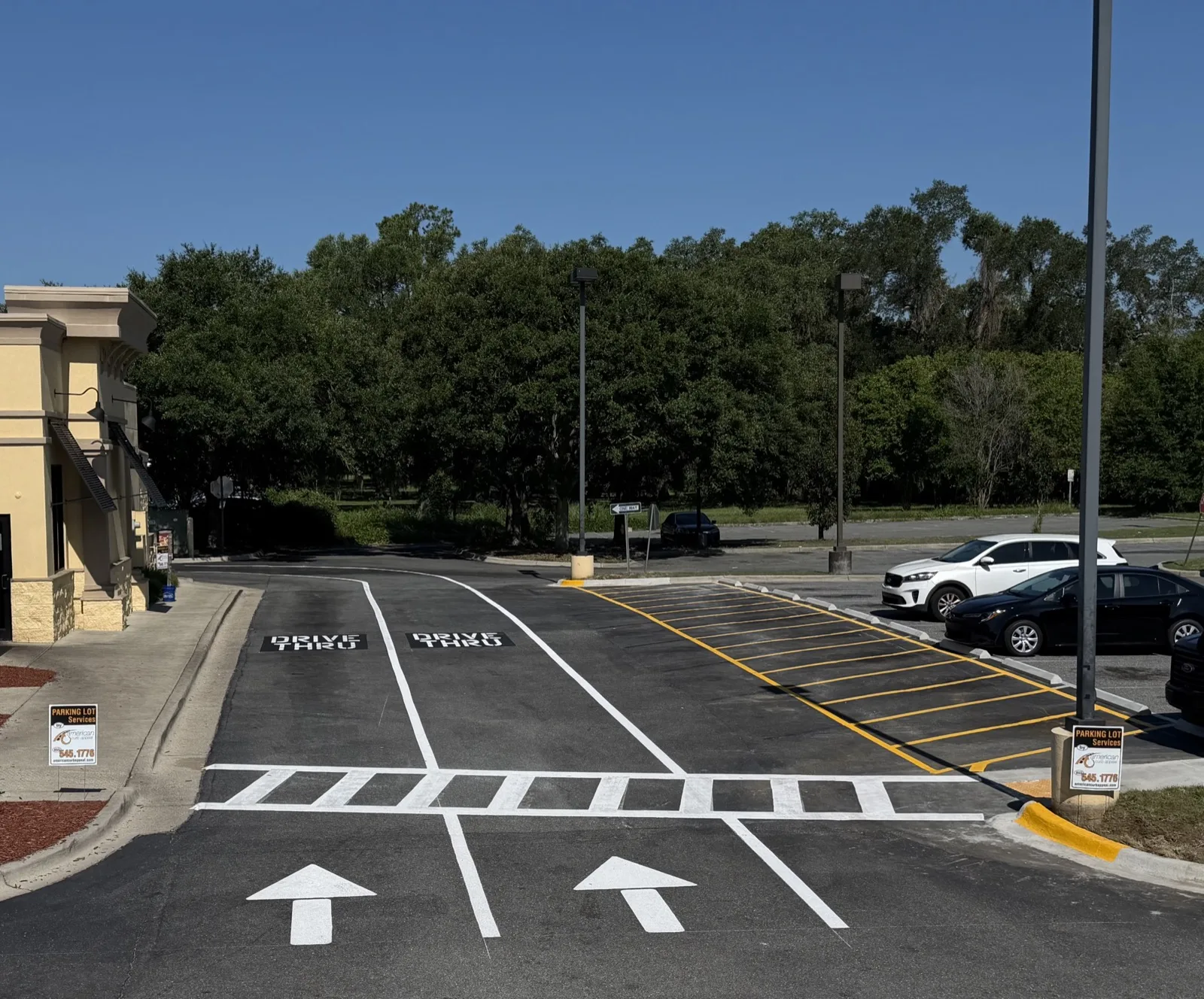
A freshly striped drive-thru lane showing the lane edge carried through the curve toward the window.
Order Point, Window, and the Walk to the Front Door
Inside the lane there are a handful of markings that each solve one problem.
Order point and window stop markings
A stop bar or stop legend at the menu board tells the driver where to pull to, which keeps the speaker and the camera lined up and keeps the car behind from creeping. The same marking at the window keeps the pickup position consistent. When these are missing, drivers stop a few feet short, and over a long line those few feet multiply into lost stacking space.
Merge and lane assignment
Dual order points need markings that tell each driver which lane they belong in and where the two lanes become one. A merge that is not marked becomes a negotiation at the window, and negotiations are slow.
The pedestrian crossing
The crossing between the parking rows and the front door is the most dangerous stripe on a restaurant property. Drive-thru drivers are watching the car ahead and the window, not the sidewalk. A clearly marked crossing, placed where people actually walk rather than where it was convenient to paint, gives the driver a reason to look up. That crossing is also part of the continuous route that connects accessible parking to the entrance, which has to be stable, firm and free of trip hazards. We handle that side of the property under ADA & Florida Accessibility Compliance, including the 12 foot stall with the 5 foot hatched access aisle and the no parking markings inside it.
Arrows, Bypass Lanes, and the Parking Side
The failure mode nobody plans for is the parking lot jamming behind the queue. A customer who parked, ate and wants to leave should never have to cross or wait on the drive-thru line. That is what directional arrows and a bypass or escape lane are for.
| Marking | What it prevents |
|---|---|
| Lane edge lines through the curve | Cars drifting wide, clipping curbs, stacking two abreast |
| Stop bar at order point and window | Short stops that waste stacking depth |
| Merge markings at dual order points | Window conflicts between two lanes |
| Directional arrows in parking rows | Parked customers feeding into the queue by mistake |
| Bypass or escape lane striping | A single stalled order holding the whole line |
| Marked pedestrian crossing | Walk-in customers crossing an inattentive queue |
Bank lanes we stripe in the smaller towns around us, including Havana and Monticello, run into the same thing. A teller lane and an ATM lane have to be told apart from twenty feet back, and the escape lane has to be obvious to the driver who just wants to leave. The principle is identical on a restaurant lot.
Curbs matter here too. A broken curb at the nose of an island stops guiding traffic and starts letting water under your asphalt, which is why we often pair lane work with Concrete Construction & Repair on the islands and sidewalk panels that frame the lane.
Getting It Done Before the Rush Without Closing
Paint needs clean, dry pavement and time to cure, and a drive-thru cannot be closed in the middle of a lunch hour. So we schedule around you. Most restaurant lanes get striped overnight after close, with the lane open again before the morning shift. Larger properties get done in sections, half the parking field one night and the lane the next, with cones and a mapped route so customers always have a way in and a way out. We walk the lot with you first and put the scope in writing, broken out so you can see what is being striped, what is being brought up to ADA code and what is optional.
American Curb Appeal has been doing this work out of Tallahassee since 1998, across Crawfordville, Quincy, Havana, Monticello, Perry, Madison, Lake City, Apalachicola and Live Oak. If you want your lane measured and marked before your busiest weeks, call us at (850) 545-1776 or request a walkthrough through our parking lot striping and precision layout page and we will come look at the lot.
One of our long-time clients put it this way:
"Terry has been doing work for us for the past 15+ years. He can handle all types of asphalt repairs, installs, striping, curbing, and misc concrete work. No job is too big or too small for American Curb Appeal so give Terry a call today!" Trey V., Tallahassee
FAQs
How do we get a bid for striping our drive-thru and lot?
Call or send the request through the site and we will come walk the lot. For commercial properties we put the numbers in writing with the scope broken out, so you can see what is being striped, what is being brought up to ADA code and what is optional, rather than one lump figure. That walkthrough is also when we flag anything in the lane that should be repaired before paint goes down.
Can you stripe without closing the restaurant?
Yes. Most drive-thru lanes are striped overnight after close so the lane is usable again for the next shift. Larger lots get handled in sections with a coned route so customers always have access.
The pavement in our drive-thru wheel path is cracking. Should we stripe over it?
Not before the pavement is addressed. Cracks let our heavy rains reach the limerock base, and a saturated base under a lane that takes the same wheel load all day turns into a pothole. We would look at Asphalt Crack Repair or a full depth patch first, then stripe.
Why does new construction experience matter for a simple restripe?
Contractors who only do maintenance have not had to get a layout right the first time for an inspection. Knowing how the layout was engineered is what lets us re-map a lane for more stacking depth instead of just repainting what was already there.
Need parking lot maintenance?
Contact us today for a free proposal on your next pavement project.
Get Your Free Proposal