
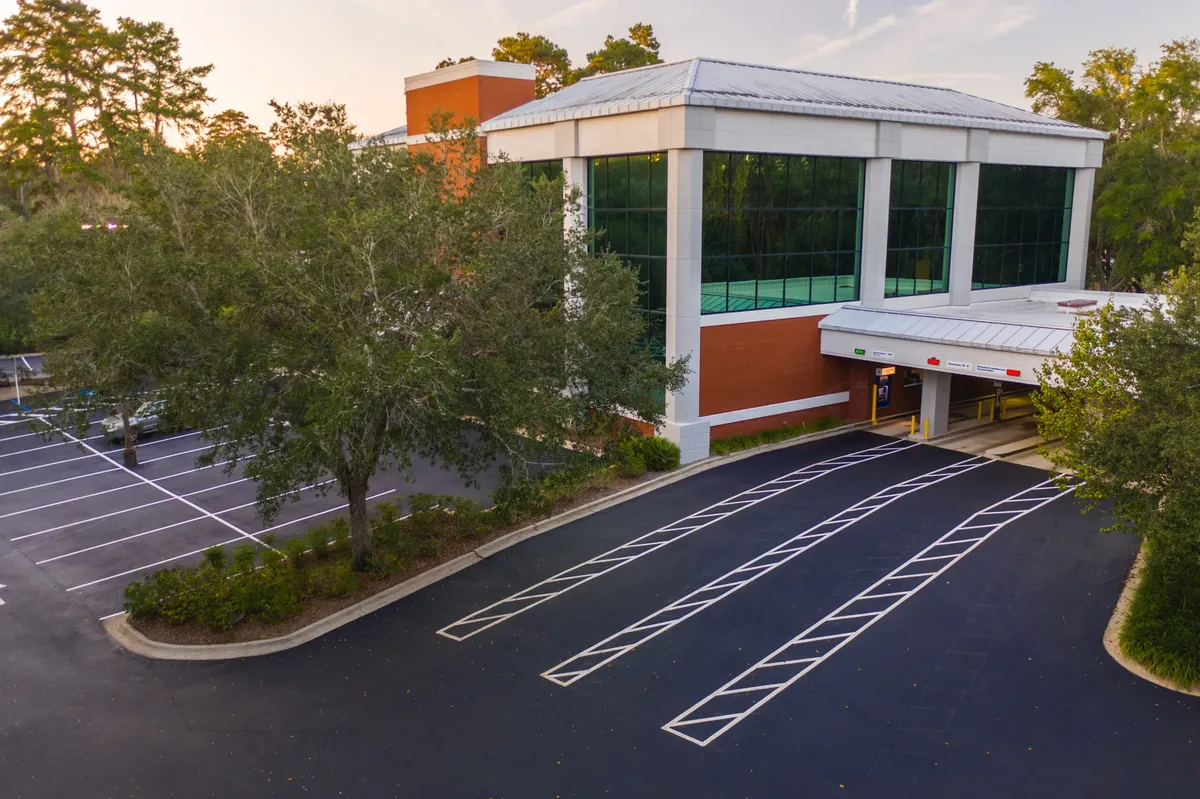
Most front door trip hazards are concrete problems, and almost all of them are visible to anyone who walks the entrance slowly and looks down. A settled panel, a joint that has opened up, a crumbling curb end or a ramp with a lip at the bottom all sit between the parking space and your door. We have been repairing this exact stretch in Crawfordville and across North Florida since 1998.
Here's the short version:
- The hazard zone is short. It runs from the accessible stall, across the aisle, up the ramp and along the sidewalk to the door.
- Settled, heaved and spalled concrete is the usual cause, and the fix depends on whether the slab is still supported from underneath.
- An accessible route has to stay under a 2 percent slope in any direction, which is why leveling is part of a real repair, not an extra.
- November is the month to handle it, because foot traffic at the front door climbs through the holidays.
The Short Stretch Where Most Falls Happen
A customer's experience of your property starts in the parking lot, but the risk concentrates in the last few dozen feet. That is the "path of travel," the continuous unobstructed route that connects an ADA parking space to the building entrance. It has to be stable, firm and slip resistant, with no trip hazards and no excessive slopes. Every joint, panel edge and ramp transition along that route is a place where a shoe can catch.
In a commercial lot, concrete is the framework that holds everything together. Sidewalks carry people and curbs manage storm water, so when either one fails it stops being cosmetic. A heaved panel in the middle of a walkway is a liability sitting in plain sight.
What Actually Goes Wrong
Settled and lifted panels. Sidewalks are poured in sections, and each section moves independently. When the soil under one washes out or compresses, that panel drops while its neighbor stays put, leaving a vertical lip at the joint. Lifted panels do the same thing in reverse, usually from root pressure underneath.
Joints that have opened up. Over time the gap between panels widens and the filler disappears. Water runs down into the gap, takes soil with it, and the panel edges begin to break away. An open joint is both a trip point and the reason the next failure shows up.
Spalled curb ends. Curb ends at the head of a stall or beside a ramp take the most abuse. Tires clip them, water sits against them and the surface flakes off in layers. Broken curbing also allows water to undermine the asphalt behind it, which is how a small concrete problem turns into a pavement problem.
Ramp lips. A ramp is only as good as its bottom transition. If the asphalt in front of the ramp has settled, or the ramp sits slightly high, you get a lip right where a wheelchair caster or a toe lands.
Slope drift. A stall or landing that was poured flat can settle into a slope over the years. Once the slope exceeds 2 percent in any direction, the space stops functioning as an accessible one, no matter how fresh the paint looks.
Repair or Replace the Panel
The question we get on nearly every concrete call is whether a cracked slab can be saved. It comes down to one thing: whether the slab is still supported underneath.
Cracking on a slab that is otherwise flat and solid underfoot is a repair. We can fill, resurface or replace that individual section without touching the rest of the walkway. Once a slab has sunken, once it rocks under weight or once the soil beneath it is gone, filling the crack accomplishes nothing. The slab has to come out and we repour.
A commercial sidewalk joint where one panel sits lower than the next, creating a vertical lip in the path of travel.
| What you see | Usually a repair | Usually a cut out and repour |
|---|---|---|
| Hairline or moderate cracking, slab flat and firm | Yes, fill or resurface the section | |
| One panel sitting below its neighbor | Yes, the support underneath is gone | |
| Slab rocks or moves under foot traffic | Yes | |
| Surface flaking on a curb end | Rebuild the damaged curbing | |
| Ramp with a lip at the bottom transition | Sometimes, depending on cause | Yes, if the landing has settled |
| Slope over 2 percent across an accessible stall | Yes, leveling and slope correction |
If settlement in front of a ramp turns out to be the real culprit, the asphalt side becomes a full depth Asphalt Restoration & Structural Repair item. We remove the failed asphalt down to the base material and excavate the edges of the repair area so a full thickness of asphalt goes back in, rather than skimming over the low spot.
Why November Is the Month to Deal With It
Front door foot traffic climbs through the holidays. More people, more bags in hands, and more shoppers who have never been on your property before and do not know where the bad joint is. A lip that regular customers have learned to step over becomes a genuine hazard to a first time visitor carrying boxes.
The work itself also suits this part of the year. Sidewalk and curb repair is sectional, so we can take out and repour a panel at a time, keep a walkable route open, and stage the work around your hours.
While a crew is on site, it is worth asking about the paint. If accessible stalls need repainting after leveling, the striping and the hatched access aisle get reset at the same time. Our Parking Lot Striping & Precision Layout crews work off measured layouts rather than eyeballing lines, and our ADA Compliance & Signage Guide covers how Florida's blue and white signage and no parking markings have to line up with the stall geometry underneath them.
Your Ten Minute Walk the Front Checklist
Park in the accessible stall and walk to your own door the way a customer would.
- Stand in the accessible stall. Does water pool here after rain? Pooling is a slope clue.
- Look at the access aisle. Are the hatch marks and the no parking markings still readable, or faded to gray?
- Walk the ramp. Run a shoe toe across the bottom transition. Feel a lip? Note it.
- Watch the joints along the sidewalk. Any place where one panel sits visibly lower than the next goes on the list.
- Tap suspicious panels. A slab that rocks or sounds hollow has lost support underneath.
- Check the curb ends. Look for flaking, missing chunks and exposed aggregate at stall heads and ramp edges.
- Look at the asphalt right against the concrete. Separation there means water is getting under the slab.
- Check the route for obstructions. Anything narrowing the path, from planters to carts.
- Do it again at night. Lighting changes what a customer can see at their feet.
- Photograph every item. Dated photos are how you track what is getting worse.
Anything involving a vertical lip, a rocking slab or standing water in an accessible space should move to the top of the list. Those three combine a real fall risk with an accessibility problem.
Get Your Crawfordville Entrance Looked At
We are American Curb Appeal, out of 1336 Timberlane Rd in Tallahassee, and we have spent 28 years on the lifecycle of existing commercial pavement and concrete in this region, Crawfordville included. We are insured and bonded, our concrete crews pour new work every week, and we handle sidewalk restoration, trip hazard removal, curb and gutter rebuilds and ADA ramps. We do not quote a square foot number sight unseen, because it depends on how many panels are involved, whether the base has to be rebuilt and whether slope correction is in play. We come walk the property and put the scope in writing with the compliance items separated from the optional ones.
To get on the schedule, see our Concrete Construction & Repair services or call (850) 545-1776.
FAQs
My sidewalk is badly cracked. Does the whole walkway have to come out?
Almost never. It comes down to whether the slab is still supported underneath. Cracking on a slab that is otherwise flat and solid is a repair, and we can fill, resurface or replace individual sections without touching the rest. Once a slab has sunken or rocks under weight, that section gets cut out and repoured.
What slope is an accessible route allowed to have?
A slope exceeding 2 percent in any direction turns a parking space or landing into a problem, which is why leveling and slope correction is part of the repair rather than an add on. We measure it instead of judging by eye. If the grade has drifted, correcting it is what makes the rest of the work count.
Can you fix the broken curb at the same time as the sidewalk?
Yes, and we usually recommend it. Broken curbs let water get behind them and undermine the asphalt, so leaving one while repairing the walkway next to it just sets up the next repair. We reconstruct damaged curbing as part of the same visit.
Do you also pour new concrete, like a ramp or a pad?
Yes. Our concrete crews pour new work every week, including ADA ramps, sidewalks, aprons, driveway extensions, dumpster pads and equipment pads. What we do not do is new asphalt paving. If you want more parking area and you are open to concrete, we can form and pour it.
How do I get a number for the work at my Crawfordville property?
Call or send the request through our site and we will come walk the property. For commercial jobs we put the numbers in writing with the scope broken out, so you can see what is being repaired, what is being brought up to ADA requirements and what is optional, rather than one lump figure.
Need parking lot maintenance?
Contact us today for a free proposal on your next pavement project.
Get Your Free Proposal