
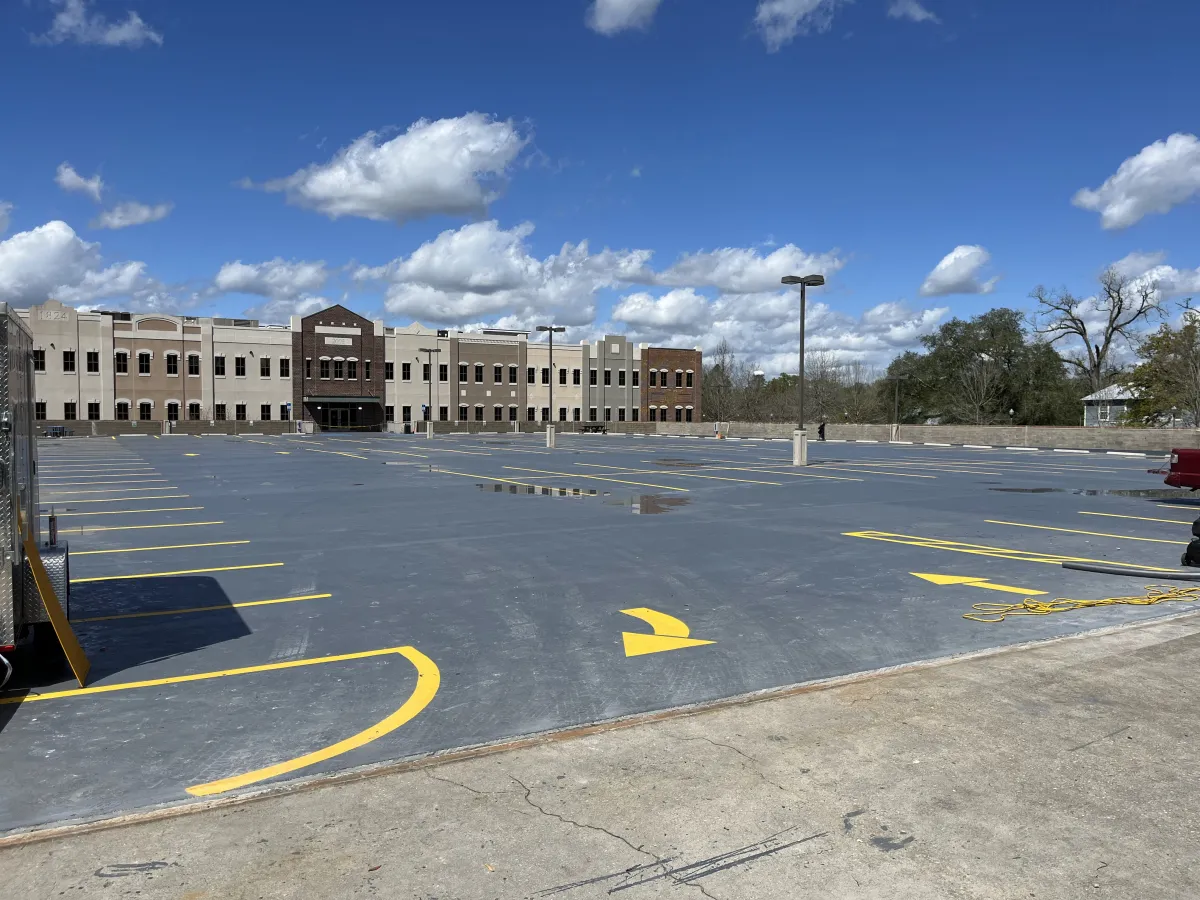
Walk the lot on foot, write down every faded line, missing arrow and broken edge, then fix the safety and traffic flow items first. Holiday traffic does not forgive a lot that is hard to read. Drivers who cannot see where a stall ends start making their own decisions. That is when fender benders, blocked fire lanes and tenant complaints begin.
Here's the short version:
- Walk the lot slowly on foot and in a car, in daylight and after dark, before you call anyone.
- Stall lines, arrows, stop bars, fire lanes and crosswalks change driver behavior the most for the least money.
- Potholes at the entrance drive deserve attention early, because that is where every vehicle enters.
- Work can be sequenced in coned sections with fast-cure paint so no tenant loses a day of parking.
- If the year-end budget is short, fund safety and accessibility first and cosmetic items later.
Start With a Walk, Not a Work Order
Most property managers call us after a tenant complains. The better order is to walk the lot first. That way you know the whole picture instead of the one corner that generated the phone call.
Take two passes. On foot, you see cracks, crumbling edges, sunken concrete and faded symbols. In a car, you see what a shopper sees. That means whether the lanes read clearly at five miles an hour with glare on the windshield. Then come back after dark. A lot that looks acceptable at noon can be nearly unreadable under parking lot lighting once the paint has oxidized to gray.
Write each item down with a location. "South row, lines gone" is more useful than "needs striping." When we walk the lot with you, that list is what lets us break a bid into scope items you can make decisions about.
What to Look at on the Pavement
Stall lines and curb markings
Faded stall lines cost you parking capacity. Drivers straddle where they cannot see a line, so a row holds fewer cars than it should. Look for lines that have gone chalky gray and for stalls where the paint has worn off in the wheel paths.
Directional arrows and stop bars
Arrows and stop bars are the cheapest traffic control you own. In a center with one busy entrance drive, arrows keep a shopper from turning the wrong way into oncoming traffic. If they are faint, they are not doing their job.
Fire lanes and no parking zones
Red fire lane curbing and no parking hatching fade faster than most owners expect. They sit in the sun and take direct tire contact. When those markings disappear, people park in them. During the holidays, people park in them for an hour.
Crosswalks and the path from accessible stalls to the storefronts
This is the item we see skipped most often. The accessible stalls may be striped correctly while the crosswalk from those stalls to the door has worn away. The path of travel is the continuous, unobstructed route connecting an accessible space to the building entrance. It has to be stable, firm and slip resistant, with no trip hazards or excessive slopes. Our ADA & Florida Accessibility Compliance work covers the stall geometry, the access aisle and the signage together, because the pavement and the path have to match.
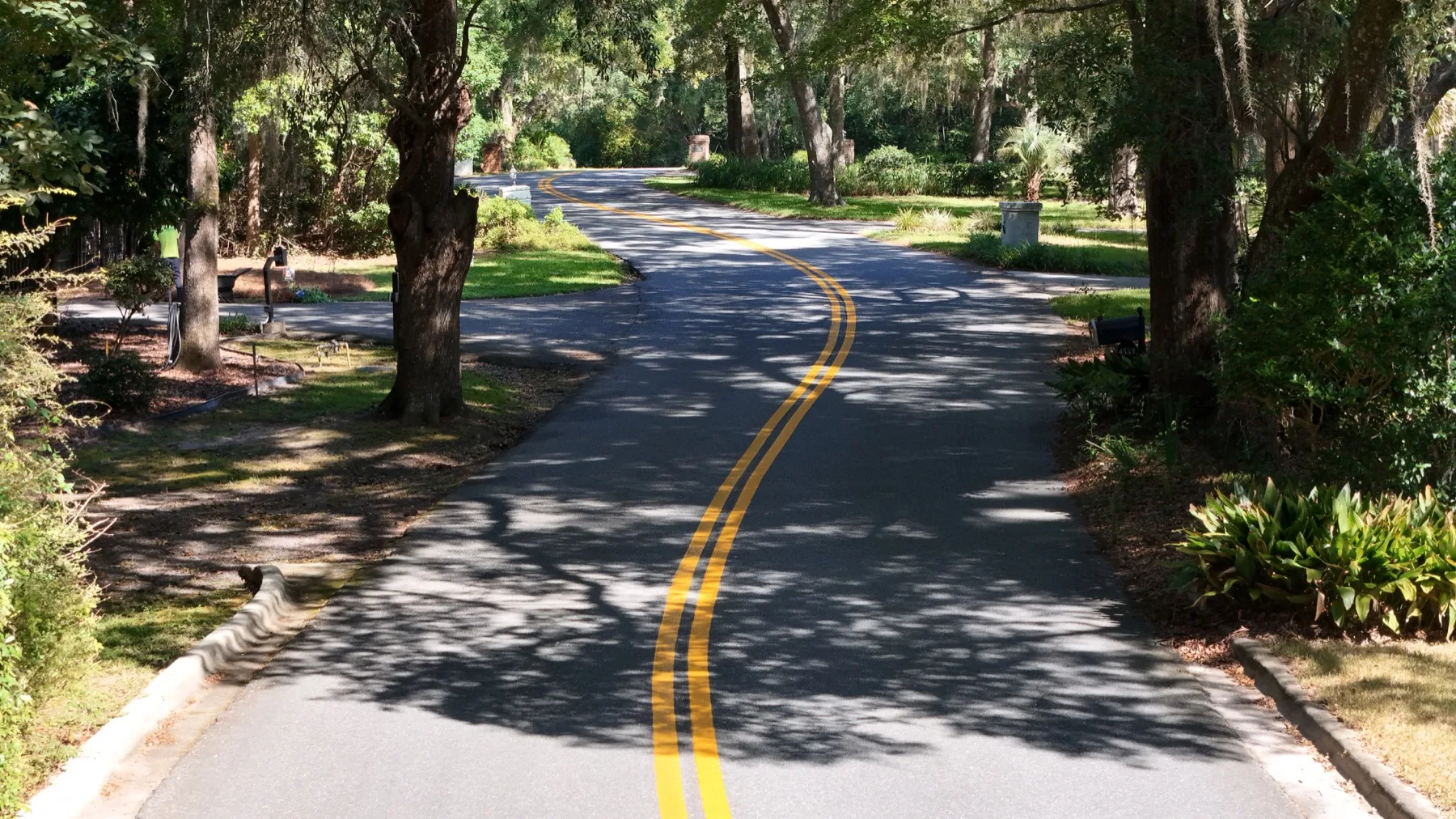
A shopping center drive aisle with fresh stall lines, directional arrows and a painted crosswalk running toward the storefronts.
Cart corral placement
Corrals placed years ago often sit in the wrong spot now. If a corral blocks a sight line or sits too far from the storefront, shoppers abandon carts in stalls and you lose usable spaces. A restripe is the moment to move the corral footprint and repaint around the new location. Because we understand the civil engineer's reasoning behind the original layout, we can re-map a row without creating a new problem elsewhere.
Potholes at the entrance drive
Every vehicle that visits the center crosses the entrance. That is why entrance drives fail first and why they are worth repairing before December. We do not throw and go. We remove the failed asphalt to reach the base material and excavate the edges so a full thickness of asphalt is achieved. Then we use professional grade liquid asphalt tack to weld the new hot mix to the old. More on that is on our Asphalt Restoration & Structural Repair page.
Cracks running through the lot should be addressed while the crew is out there. An open crack sends heavy Florida rain straight to the lime rock base under the asphalt. Once that base stays wet, it loses the ability to carry vehicle weight.
Sequencing the Work So Tenants Never Lose a Day
Owners usually assume a restripe means closing the lot. It does not. We break the lot into sections, cone off one section at a time, and move with the traffic pattern instead of against it. A back row, or a row in front of a tenant that opens later, gets done while the rest of the lot keeps operating.
Fast-cure paint is what makes that possible. A coned section can go back into service the same day rather than sitting empty overnight. For repair work, the patch area is the only part that is closed, and the surrounding stalls stay open.
We also schedule around tenant hours rather than our own convenience. Restaurants, theaters and anchor tenants do not share the same peak, so the order of the sections matters. For how a layout is planned before a brush touches pavement, our write up on what goes into a new parking lot striping layout covers the measuring and math. Our piece on how parking lot striping improves safety in Lake City explains why the markings change driver behavior.
If the Year-End Budget Only Covers Part of the List
Most lots we look at do not need replacing. That is the whole reason this company exists. If the surface is cracked, dull or has isolated potholes but the pavement is still solid underfoot, that is a repair and preservation job. It can be staged across budget cycles.
Here is how we help owners rank a partial list.
| Priority | What it covers | Why it goes here |
|---|---|---|
| Fund first | Accessible stalls, access aisles, path of travel, fire lanes, entrance drive potholes | Safety and liability items that do not wait for a budget year |
| Fund next | Stall lines, directional arrows, stop bars, crosswalks | Directly affects traffic flow and usable capacity during the rush |
| Fund later | Sealcoating, crack sealing across the full lot, curb and cart corral changes | Preservation work that is better handled in a planned window |
Sealcoating is worth its own note. It is a protective skin, not a structural filler, so it will not close cracks. Hot-applied crack sealing comes first so water cannot reach the base. Then High-Performance Sealcoating & Preservation provides the UV protection for the surface.
Working With American Curb Appeal in Lake City
We have specialized in the lifecycle of existing commercial pavement since 1998. We work with property managers, shopping centers, restaurants and theaters across North Florida, including Lake City. Call or send the request through the site and we will come walk the lot with you. For commercial properties we put the numbers in writing with the scope broken out. You see what is being striped, what is being brought up to ADA code and what is optional, rather than one lump figure.
If you manage a center here, start with our Lake City parking lot services page or call us at (850) 545-1776.
"American Curb Appeal does an incredible job at a very fair and competitive price. Terry is a great communicator, and his attention to detail is exceptional. Highly recommend this company for any asphalt needs." Noah C., Tallahassee
FAQs
How late in the year can we still get a lot restriped before the holidays?
It depends on the weather window and how much of the lot needs work. Call us and we will tell you honestly what fits. Striping with fast-cure paint moves quickly in coned sections, which gives us more scheduling flexibility than full depth asphalt repair does. Repair work needs dry conditions, so it benefits most from being booked early.
Will shoppers lose parking while the work is happening?
No. We cone off one section at a time and keep the rest of the lot open. We then move through the lot in an order that works around tenant hours. Fast-cure paint lets a section go back into service the same day instead of sitting closed overnight.
Our accessible stalls look fine. Do they still need checking?
Yes, because the stalls are only half of it. Florida requires specific stall and aisle dimensions, blue and white signage, and no parking markings inside the access aisle. The route from the stall to the entrance also has to be unobstructed, with no trip hazards or excessive slopes. A slope over two percent in any direction turns a compliant looking space into a problem.
Should we patch the entrance potholes or repave the drive?
Walk it with us before deciding. If the pavement is still solid underfoot and the failures are isolated, a full depth repair down to the base is the right call. Widespread failure across the whole drive is the signal that changes the answer.
Need parking lot maintenance?
Contact us today for a free proposal on your next pavement project.
Get Your Free Proposal