

A parking lot is, first, about establishing order, and the order only works if the layout works on real pavement and not just on paper. I have spent 40 years building parking lots and then marking them to the plans of engineers and architects. That time has taught me how often the two do not line up, and what it takes to catch the difference before it becomes the owner's problem.
Here's the short version:
- Drivers trust a parking lot without thinking about it
- A flat drawing does not always fit real pavement
- Experience catches the flaw, ethics speaks up about it
The Quiet Trust Drivers Put in a Parking Lot
When a driver pulls off a busy street into a commercial parking lot, something shifts. On the open road, order comes from traffic signals, barriers and enforcement. The moment a car crosses onto private pavement, most of that disappears.
In its place is an unspoken agreement between strangers. Drivers trust that pedestrians will cross where they are supposed to. Pedestrians trust that cars will move at a safe crawl. Everyone trusts that the space itself will guide them without confusion. They also trust, without ever thinking about it, that the people who designed and built the lot followed the rules.
When that order holds, the parking lot becomes invisible. Customers park, walk inside and do business. When it fails, with stalls that are too tight, sightlines that are blocked or aisles that choke up, drivers feel it right away. Before a customer ever reaches the door, a poorly laid out lot has already hurt their visit.
For property owners, facility managers and developers, a parking lot is more than paved land. It is the first impression of the property, a working part of the business, and if it is laid out poorly, a quiet liability.
The Gap Between Paper and Pavement
Most owners assume that if an engineer or architect signed off on a layout, it will work in practice. The plan looks precise and orderly on the screen.
A drawing, though, lives on one perfectly flat plane. Real asphalt does not. Real pavement has grade changes, drainage pitch, curbs, the turning room a long modern truck actually needs, glare, blind spots and people who do not always do what the drawing expects.
I started out building parking lots from the ground up and then spent decades marking them, and I have seen how often a design on paper runs into the real world. A turn into an aisle can look clean on the plan and still be a tight spot on the ground where drivers clip the curb or block oncoming cars. A stall count can look maximized on paper and still leave a few spaces so awkward that nobody wants to park in them.
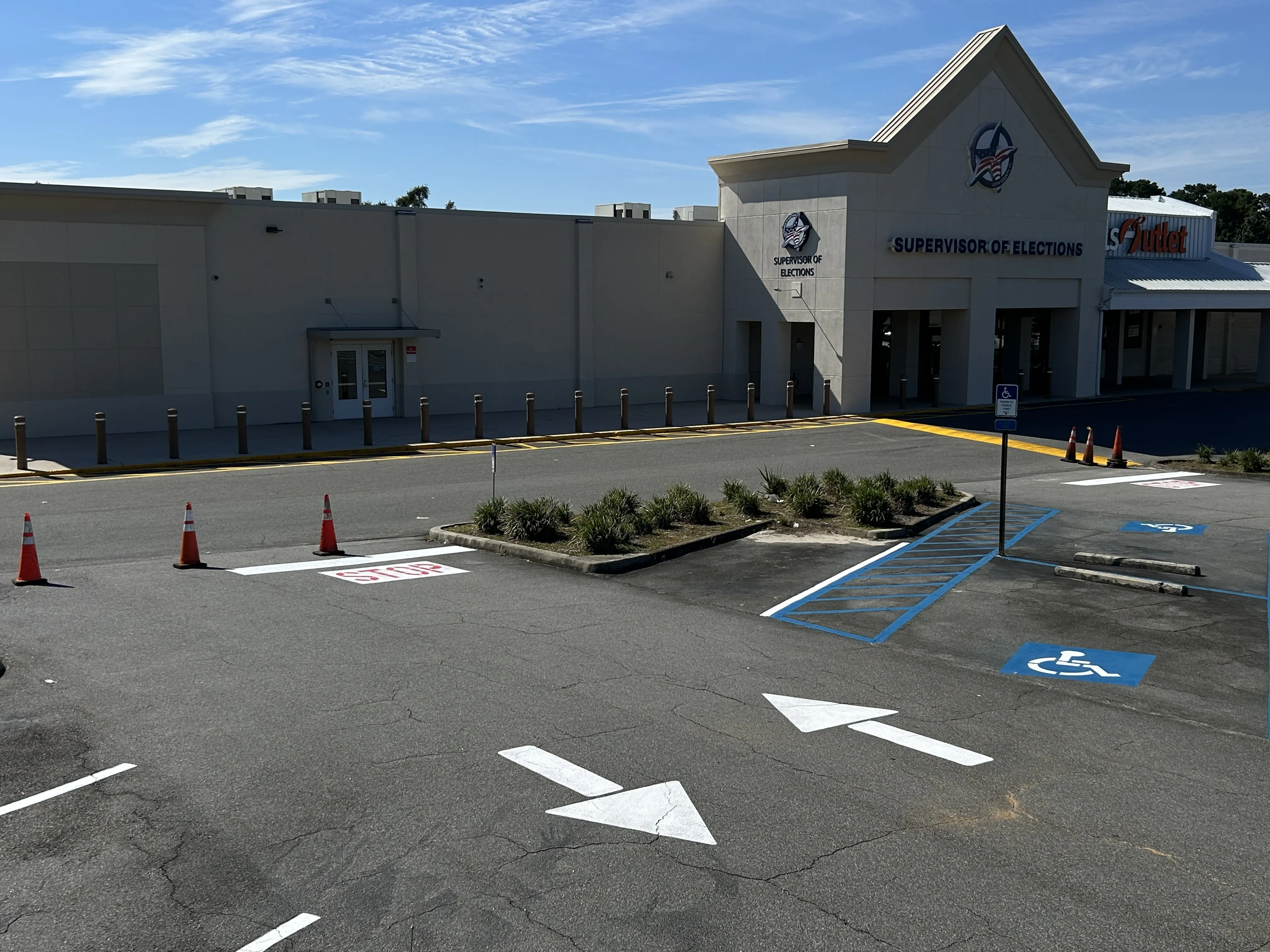
Fresh stall lines and markings on a commercial lot in the Tallahassee area.
Catching Design Flaws With Experience and Integrity
When a striping crew arrives on a new construction job, the plans are the plans. We do not have the option to do our own thing to make a layout better. We have to install exactly what the engineer or architect drew.
If a plan has a problem, such as a turn that is too tight, a stall angle that creates a bottleneck or a crosswalk drivers cannot see, painting it without a word means the owner inherits the consequences.
- More risk. Blind corners and awkward crossings make low speed collisions and trips more likely.
- Frustrated customers. Cramped stalls, hard turns and unclear traffic flow make every visit harder.
- Wasted money. Fixing a bad layout after the paint is down costs time, money and disruption for tenants.
This is where experience changes the outcome. Having built the ground underneath, the grading, the base and the drainage, lets you read a plan as a real three dimensional place and not just lines on a page.
Catching the flaw is only half of it. The other half is speaking up. What we can do is alert the job foreman to the issue and give them a better alternative. Whether that goes back to the engineer is the foreman's call, and in the end we install what is on the plans. Having the experience to catch it, and the responsibility to bring it up, is what separates a crew that just checks boxes from one that takes the work seriously.
Giving Older Parking Lots a Better Layout
A layout is not permanent. A lot designed decades ago was laid out for the way people drove and used that property at the time.
Over the years, a property's needs change:
- Bigger vehicles. Today's trucks and SUVs need more room than the cars many older lots were drawn for.
- Pickup and delivery. Delivery vans, rideshare drop offs and curbside pickup need space of their own, away from regular parking.
- New tenants. When a store becomes a medical office or a restaurant, the amount and timing of traffic in the lot changes with it.
You do not always need to tear out the asphalt to solve these problems. Looking at an outdated layout with real vehicles and real traffic in mind, a redesign can add usable spaces, set aside delivery and pickup areas, bring accessible parking up to code and clean up dangerous intersections, all with smart layout and fresh parking lot striping. If you want to see how a layout comes together step by step, we walk through it in what goes into a new parking lot striping layout.
Order Built on 40 Years of Experience
A good parking lot layout is not an accident. It starts with the ground underneath, gets proven on real pavement and stays clear because the lines are right.
When drivers pull onto your property, they trust the lines under their tires without a second thought. Making sure those lines fit the real world and not just a drawing protects your visitors, protects your business and protects the value of the property.
American Curb Appeal has served Tallahassee and the Big Bend since 1998. When you need a parking lot that works in the real world, work with someone who has built them from the ground up and brings the experience and the ethics to make every line count. Call American Curb Appeal or request a free proposal through our striping page.
FAQs
Can a striping contractor change the layout on the plans?
No. On a new construction job the striping crew installs exactly what the engineer or architect drew. What an experienced crew can do is point out a problem to the job foreman and offer a better alternative. Whether it goes back to the engineer is up to the foreman.
Can an older parking lot be redesigned without repaving?
Often, yes. When tenants, vehicles or traffic patterns change, a new layout and fresh striping can add usable spaces, create pickup or delivery areas and fix awkward intersections without tearing out the asphalt.
Why does a layout that looks right on paper fail on the ground?
A drawing sits on one flat plane. Real pavement has grade, drainage pitch, curbs, real vehicle turning room and blind spots, so a turn or a row of stalls that looks clean on the plan can be tight or awkward once cars are using it.
How much experience does American Curb Appeal have with parking lot layout?
Terry Thompson has 40 years in the trade, starting with building parking lots from the ground up and then decades of marking them to engineers' and architects' plans. That background is what lets us spot a layout problem before it is painted.
Need parking lot maintenance?
Contact us today for a free proposal on your next pavement project.
Get Your Free Proposal