
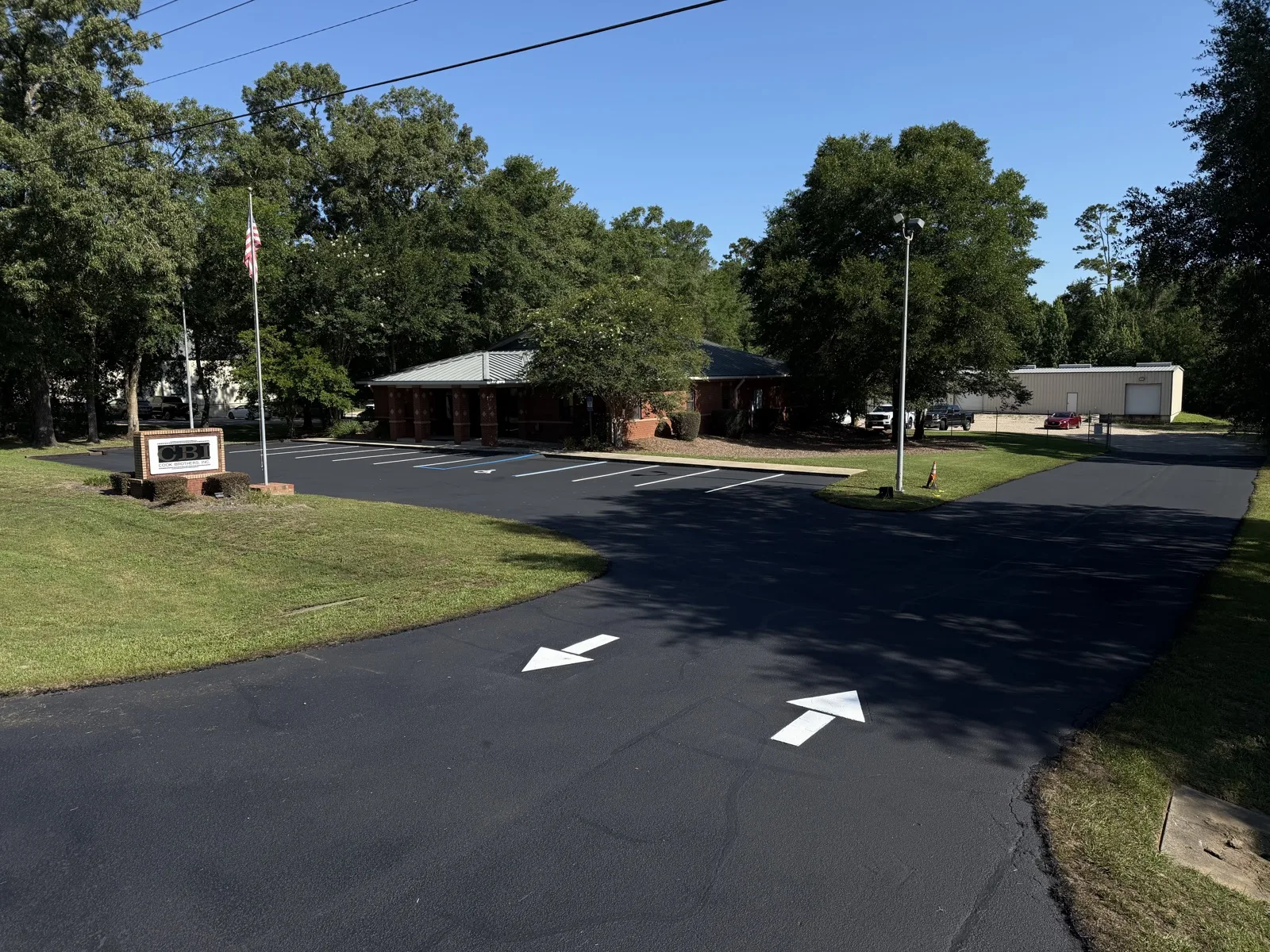
After a storm rolls through Perry, most owners check the roof and the sign out front, then forget the accessible parking stalls entirely. That is the part of the property with the tightest requirements and the highest exposure. Debris settles in access aisles, signs lean or disappear, and blue paint that was already fading now reads as a suggestion instead of a marking.
Here's the short version:
- Storm damage to ADA parking is quiet. Blocked aisles, leaning signs and washed out markings do not look like damage, so they get skipped.
- A van accessible stall is a 12 foot wide space paired with a 5 foot wide hatched access aisle. If either one is obstructed or unreadable, the stall is not doing its job.
- Slope matters as much as paint. A settled corner that pushes a stall past 2 percent in any direction turns a parking space into a hazard.
- Fresh paint over a failed surface is cosmetic. Compliance covers geometry, slope, signage and the path of travel to the door.
- You can run a five point walkthrough yourself in the time it takes to walk the lot.
Why Accessible Parking Takes the Worst of a Storm
Accessible stalls sit close to the building, which is exactly where roof runoff, gutter discharge and wind driven debris end up. Branches, pine straw, shingle grit and mud collect in the flattest, most protected spot on the lot, and that spot is very often the hatched access aisle beside a handicap stall. Because nobody parks in the aisle, nobody notices it filling up.
Heavy rain does the second half of the work. When water runs across pavement and pools, it finds any crack and travels down to the limerock base underneath the asphalt. Once that base stays wet, it loses its ability to support vehicle weight, and the surface above it starts to move. On a normal stall that shows up as a low spot. On an ADA stall, even a small amount of settling can push the surface past the slope range a wheelchair user needs to transfer safely.
The third piece is signage. Wind takes accessible parking signs down or leaves them leaning, bent or turned away from the drive aisle. A stall painted on the ground with no upright sign beside it is an incomplete stall, and it is one of the easiest things in the world for someone to photograph.
What Actually Makes a Stall Compliant
There is a common assumption that a handicap stall is just a regular space with a blue symbol on it. It is not. On the pavement side, we execute the Florida 12 foot wide parking space paired with a 5 foot wide hatched access aisle, so every space is van accessible from the start. That aisle is the working room a person needs to deploy a ramp or open a door fully, which is why a pallet, a landscape pile or a storm debris heap sitting in it defeats the whole stall.
Florida also has its own expectations that go past the federal baseline, including specific blue and white signage and no parking markings inside the access aisle. We work to the Florida Accessibility Code for Building Construction, and the details are laid out in our ADA Compliance & Signage Guide.
Then there is slope. A slope exceeding 2 percent in any direction turns a parking space into a problem, because a chair will roll and a transfer becomes unsafe. Paint cannot correct slope. That is a grading and surface question, and it is the reason we look at a stall with a level before we look at it with a striping machine.
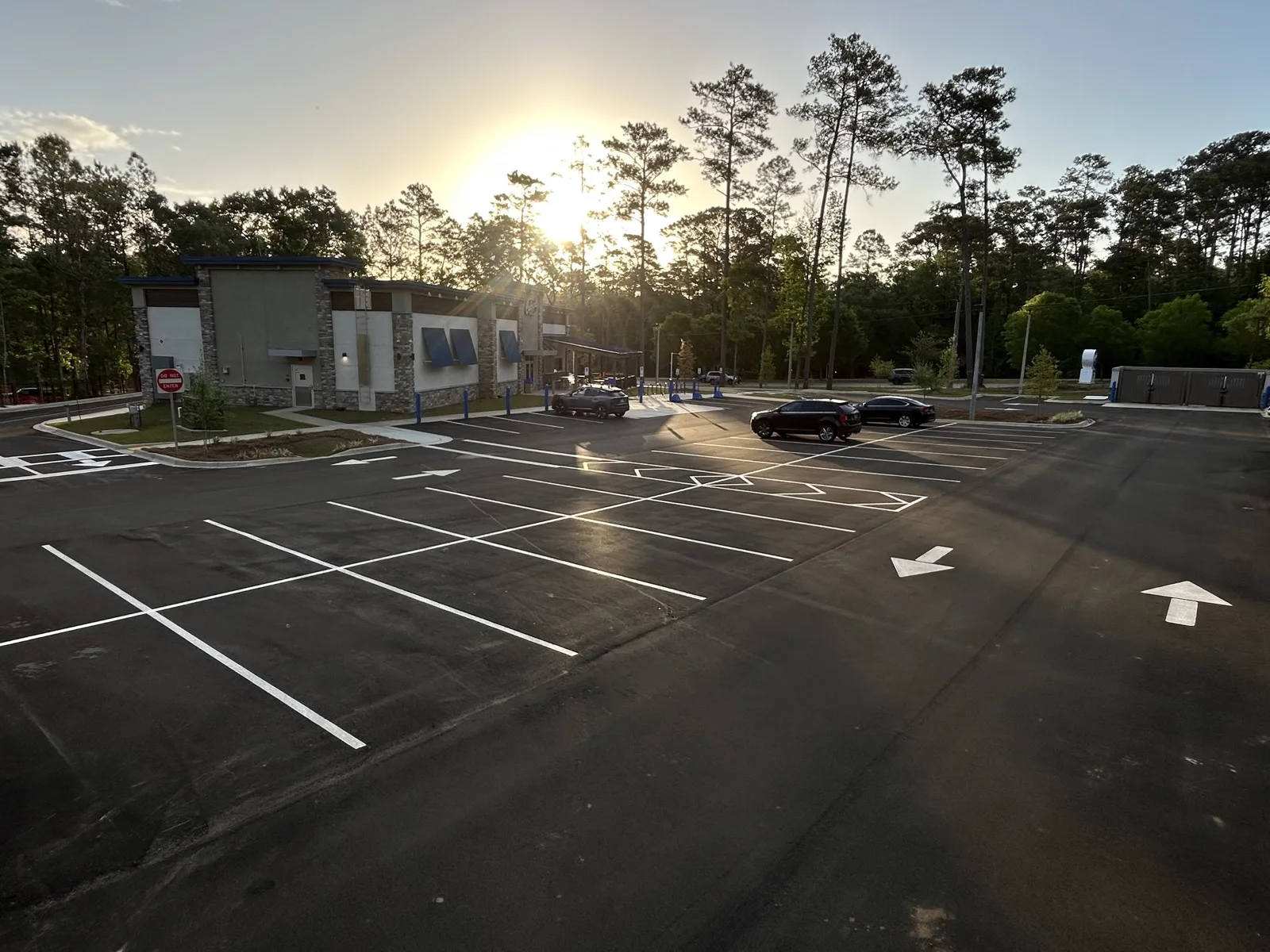
A hatched access aisle beside a van accessible stall, the area that most often collects debris after a storm.
Fresh Paint Is Not the Same as Compliance
We get calls after storms from owners who want the blue restriped so the lot looks cared for again. Sometimes striping is genuinely all that is needed. But repainting over a stall that has settled, cracked or lost its sign only makes the non compliance look intentional and recent.
| What you are looking at | What repainting alone does | What actually resolves it |
|---|---|---|
| Faded blue symbol on sound, level pavement | Restores visibility | Restriping to correct stall and aisle dimensions |
| Access aisle filled with storm debris | Nothing, the aisle is still blocked | Clear the aisle and keep it clear |
| Sign down, leaning or missing | Nothing, the stall stays incomplete | Reset or replace signage to Florida requirements |
| Stall corner settled or ponding water | Hides the low spot under new paint | Correct the slope and drainage, then restripe |
| Cracks through the stall and aisle | Paint sits on top and splits again | Seal the cracks so water stops reaching the base |
Because we understand the reason behind the original layout, we can re map a lot rather than trace what was there. That matters when a storm has already forced you to change something, like relocating a dumpster pad or rebuilding a curb. More on how layout math drives this is in The 17-Foot Envelope: Why Florida's "Wide Stall" Layout is a Specialist's Game.
The Five Point Walkthrough You Can Do Yourself
You do not need a contractor to run this. Walk it the week after the weather clears, ideally on a dry day and again while it is raining.
One, stand in the access aisle. Not beside it, in it. If you cannot stand in the full 5 foot width without stepping over debris, limbs, a planter or a parked car, the stall is out of service.
Two, look up. Every accessible stall needs its upright sign, readable from the drive aisle, straight and undamaged. Count them against your stalls.
Three, look down at the paint. If the blue symbol, the stall lines or the aisle hatching are ghosting out, worn thin by traffic or dulled by sun, they will not hold up as markings. Faded is functionally unmarked.
Four, check for water. Come back during a rain or right after one. Water pooling in or next to an accessible stall tells you the surface has moved or the runoff has changed course. That is worth fixing before anything else, because water is what breaks pavement in the first place.
Five, walk the path of travel. Go from the stall to the front door the way a wheelchair user would. The route has to be continuous, stable, firm and slip resistant, with no trip hazards. Storms lift sidewalk panels and leave lips where there were none. If you have to step over or around anything, so does your customer.
If you want that in list form to hand to a site manager, we keep a version in our ADA Compliance Checklist for Perry Properties.
Getting It Corrected in Perry
American Curb Appeal has worked on commercial pavement in North Florida since 1998, and Perry is inside our service area. We handle both halves of ADA work: the pavement side with stall geometry, hatched aisles, wheelchair symbols and slope correction, and the structural side with crack sealing, full depth repair, drainage correction, curbing and concrete for ramps and walkways. We do not do new asphalt paving. We repair, preserve and correct what you already have.
For commercial properties we put the numbers in writing with the scope broken out, so you can see what is being striped, what is being brought up to ADA code and what is optional. Start with our ADA & Florida Accessibility Compliance page or call us at (850) 545-1776 and we will come walk the lot. If striping is the only piece you need, that work sits under Parking Lot Striping & Precision Layout.
FAQs
How soon after a storm should I check my accessible parking?
As soon as the lot is safe to walk. Debris in an access aisle takes the stall out of service immediately, and that is the fastest thing to correct. The slope and drainage issues take longer to reveal themselves, so plan on a second look during the next real rain.
My blue paint is faded but the stall is otherwise fine. Is restriping enough?
If the pavement is solid underfoot, the slope is within range and the sign is standing, then yes, restriping to the correct dimensions handles it. The mistake is assuming that is true without checking. We measure the stall and aisle and check slope before we stripe.
What are the Florida specific requirements for ADA parking?
Florida has unique requirements that go beyond federal standards, including specific blue and white signage and no parking pavement markings in access aisles. We work to the Florida Accessibility Code for Building Construction on every stall we lay out.
Rainwater runs across my lot and pools near the accessible stalls. Can that be redirected?
Usually yes, and it is worth doing before you repair anything else, because water is what breaks pavement in the first place. Depending on the site we can build an asphalt berm or a curb to steer runoff away, or regrade a low area so it drains. Fixing the water first keeps the repair and the striping from failing again.
Need parking lot maintenance?
Contact us today for a free proposal on your next pavement project.
Get Your Free Proposal